Fourth Sunday of Advent – December 17

The Word

John 1:6-8, 19-28

There was a man sent from God, whose name was John. He came as a witness to testify to the light, so that all might believe through him. He himself was not the light, but he came to testify to the light.

This is the testimony given by John when the Jews sent priests and Levites from Jerusalem to ask him, “Who are you?” He confessed and did not deny it, but confessed, “I am not the Messiah.” And they asked him, “What then? Are you Elijah?” He said, “I am not.” “Are you the prophet?” He answered, “No.” Then they said to him, “Who are you? Let us have an answer for those who sent us. What do you say about yourself?” He said, “I am the voice of one crying out in the wilderness, ‘Make straight the way of the Lord,’” as the prophet Isaiah said. Now they had been sent from the Pharisees. They asked him, “Why then are you baptizing if you are neither the Messiah, nor Elijah, nor the prophet?” John answered them, “I baptize with water. Among you stands one whom you do not know, the one who is coming after me; I am not worthy to untie the thong of his sandal.” This took place in Bethany across the Jordan where John was baptizing.

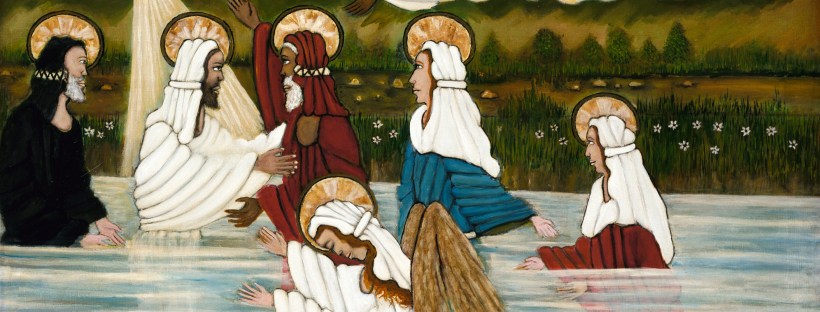
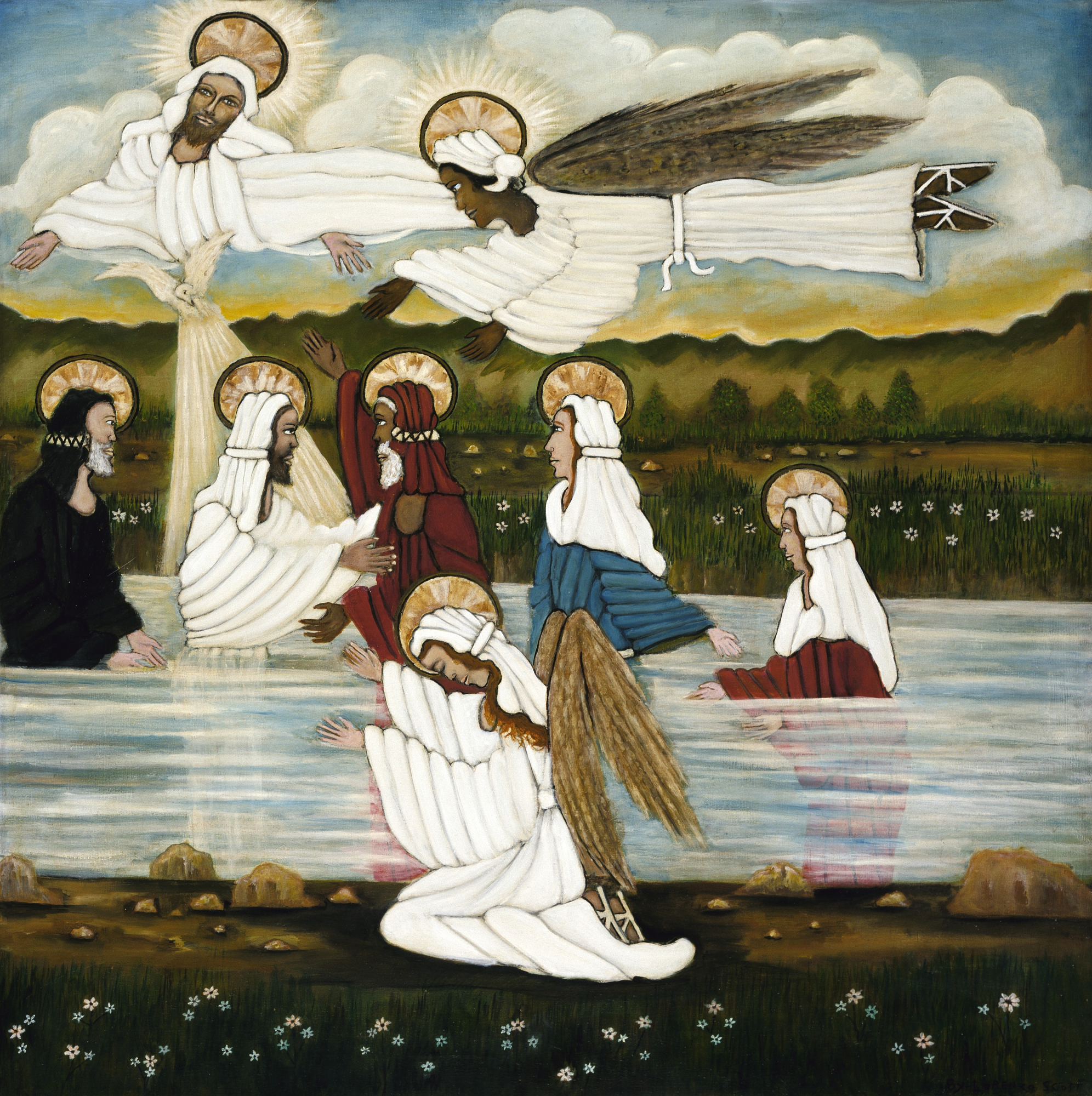
Lorenzo Scott, Baptism of Jesus, 1987, oil on canvas, 48 18 x 48 18 in. (122.3 x 122.3 cm.), Smithsonian American Art Museum, Gift of Jane and Bert Hunecke, 1994.52

Reflect

By Lisa Shaw

I’ve always felt wary of people who draw attention to their Christianity, but who judge, punish, and exclude others who don’t look or act like them. For me, announcing my faith feels too personal, evangelizing too imperious; like the Pharisees demanding answers to their questions. Indeed, even writing a devotional was a foreign concept to me before joining Westminster. In the church I attended as a child, it wasn’t practiced, leaving me to feel that maybe now I don’t have enough to say.

But my experiences over the years have opened my eyes and heart to other ways of doing things and new ways of thinking, new ways to bear witness. To me, God is less in pageantry, faithful Sundays, and recitations of the Bible and more in the small gestures of ordinary people, going about sometimes ordinary lives.

In our scripture reading, John denies being the Messiah. He is not the one to claim his righteousness or collect accolades for his work but embraces his role in welcoming and guiding others. In our world, particularly with our daughter Helena, small gestures by unassuming people live on in and around me: the ICU nurse who styled Helena’s hair while she lay unconscious in the hospital; the burly workman who approached us with tears in his eyes to give her a compliment; my friend who always remembers to leave flowers at our doorstep on Helena’s birthday. These individuals humbly walk among us, their voices, like John’s, quietly calling in the wilderness. Their efforts, more than grandiose proclamations or public displays of devotion, “make straight the way for the Lord.”

I am witness.

Listen

By Dr. Ben Hutchens

The Westminster Choristers sing a new setting of the traditional carol, “Adam lay ybounden.” It is a setting of an anonymous fifteenth century poem that speaks to the subject of original sin and subsequent redemption in the person of Jesus Christ. The premise of the poem is this: if Adam had not been tempted by Eve directly—and the serpent indirectly—there would have been no precedent for sin as we understand it; consequently, there would be no need for redemption. As such, the birth of Christ would not have been necessary as far as the Christian understanding of things is concerned. The sin of Adam constrained the development of humanity’s relationship with God for many centuries, until God himself became flesh and dwelt among us. Mary’s birthing of Jesus, as alluded to in the poem itself, allowed human beings to literally touch the face of God through his Son.  

The carol was published in 2015 and popularized through its inclusion in the 2016 Christmas Lessons & Carols program at King’s College, Cambridge. The composer, Gaynor Howard, has been involved in music education throughout her working life. She has arranged and written much instrumental and vocal music for a wide variety of occasions and forces. Her setting of “Adam lay ybounden” is written for treble voices only—a perfect fit for our choristers. Listen for the juxtaposition of the angular piano accompaniment—executed beautifully by Christine Hagan—and the lyrical vocal lines sung by our choristers.

Third Sunday of Advent – December 10

The Word

Isaiah 40:1-11

Comfort, O comfort my people, says your God. Speak tenderly to Jerusalem, and cry to her that she has served her term, that her penalty is paid, that she has received from the Lord’s hand double for all her sins.

A voice cries out: “In the wilderness prepare the way of the Lord, make straight in the desert a highway for our God. Every valley shall be lifted up, and every mountain and hill be made low; the uneven ground shall become level, and the rough places a plain. Then the glory of the Lord shall be revealed, and all people shall see it together, for the mouth of the Lord has spoken.” A voice says, “Cry out!” And I said, “What shall I cry?” All people are grass, their constancy is like the flower of the field. The grass withers, the flower fades, when the breath of the Lord blows upon it; surely the people are grass. The grass withers, the flower fades; but the word of our God will stand forever.

Get you up to a high mountain, O Zion, herald of good tidings; lift up your voice with strength, O Jerusalem, herald of good tidings, lift it up, do not fear; say to the cities of Judah, “Here is your God!” See, the Lord God comes with might, and his arm rules for him; his reward is with him, and his recompense before him. He will feed his flock like a shepherd; he will gather the lambs in his arms, and carry them in his bosom, and gently lead the mother sheep.

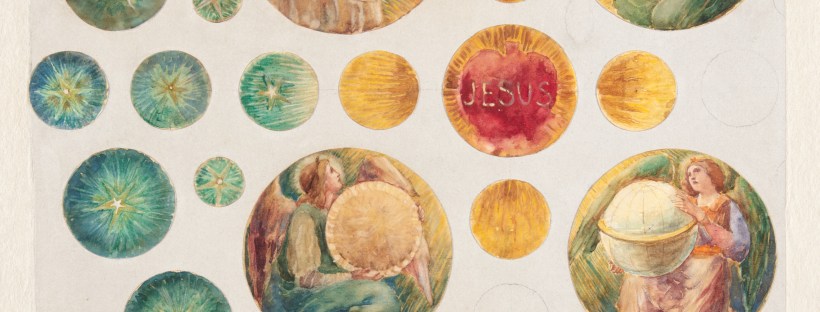
“Study for Rose Window for St. John the Baptist Church, Brooklyn, NY.” Leon Dabo, American, 1868–1960. Cooper Hewitt, Smithsonian Design Museum Collection.

Reflect

By Peter Roden

This text from Isaiah has a strong sense of the same push-and-pull that we all feel in our daily lives. In the prophecy, Isaiah compares the God of Israel, bringing the people back from exile in Babylon, to a shepherd carrying lambs. This joyous occasion comes after a period of seclusion and suffering. Although the return is celebrated it comes with new tasks, and the nation is forever changed by the experience of Exile.

It is hard in such context to avoid comparison to our own modern Exile during the pandemic shutdown. Like the people of Judah, we will be forever changed by that experience. Our common language has gained new phrases and expresses ideas previously foreign to us. Similarly, the writer of Isaiah borrows from the Babylonians their practice of building a parade-route—“make straight in the desert a highway”—for celebration of God.

Isaiah’s imagery is of a council of angels, sent by God to comfort his people; to speak tenderly. Instead, the council’s response to this is quite a lot of shouting, in addition to orders for road work! The angels remind us that we are God’s hands in the world. God is not building the highway; it is we who are called to build the highway, to shout the Good News, and to make God’s kingdom visible for all the people. If we don’t, the peoples’ faithfulness is sure to wither like grass.

And yet, our work is not enough. Worldly works fade, and only God is all-sufficient. God’s word and God’s promise are forever. Just as Isaiah calls back to Jacob’s charge in Genesis to return with his flock, so does John the Baptist call back to this charge from Isaiah. God’s word from these three disparate time periods resounds across the ages to us, ringing true once more.

In this season of anticipation, we look forward to welcoming, proclaiming, and making a path for Jesus in the desert. We can rest assured that God’s Word endures, for He was with God in the beginning, He comes again in power, and His reward is with Him.

Listen

By Dr. Ben Hutchens

Westminster’s Adult Choir sings a favorite anthem, “E’en So, Lord Jesus, Quickly Come,” by American composer Paul Manz. This anthem is a perennial favorite of our choir and I most often program it during the seasons of Advent.  Of course, the text not only provides us with a sense of longing for the coming of the Christ Child, but also for the promised return of Jesus, our Great High Priest. Paul and (wife) Ruth Manz wrote “E’en So, Lord Jesus, Quickly Come” in 1953 during a time when their three-year-old son was critically ill. Reflecting on the time, Ruth Manz reported, “I think we’d reached the point where we felt that time was certainly running out so we committed it to the Lord and said, ‘Lord Jesus quickly come.'” During this time, she had prepared some text for Paul for a composition based on the Book of Revelation. While at his son’s bedside, Paul Manz began drafting the composition, which later became the current piece. Their son did recover, which the couple attributed to the power of prayer.

Second Sunday of Advent – December 3

The Word

Mark 13:24-37

“But in those days, after that suffering,

the sun will be darkened,
and the moon will not give its light,
and the stars will be falling from heaven,
and the powers in the heavens will be shaken.

Then they will see ‘the Son of Man coming in clouds’ with great power and glory. Then he will send out the angels, and gather his elect from the four winds, from the ends of the earth to the ends of heaven.

“From the fig tree learn its lesson: as soon as its branch becomes tender and puts forth its leaves, you know that summer is near. So also, when you see these things taking place, you know that he is near, at the very gates. Truly I tell you, this generation will not pass away until all these things have taken place. Heaven and earth will pass away, but my words will not pass away.

“But about that day or hour no one knows, neither the angels in heaven, nor the Son, but only the Father. Beware, keep alert; for you do not know when the time will come. It is like a man going on a journey, when he leaves home and puts his slaves in charge, each with his work, and commands the doorkeeper to be on the watch. Therefore, keep awake—for you do not know when the master of the house will come, in the evening, or at midnight, or at cockcrow, or at dawn, or else he may find you asleep when he comes suddenly. And what I say to you I say to all: Keep awake.”

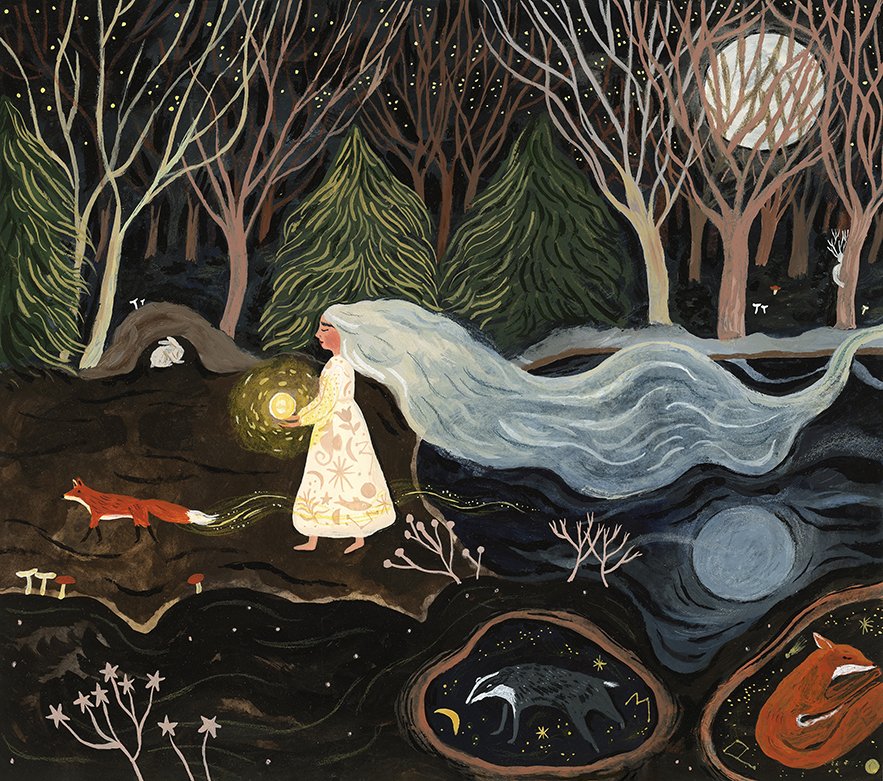
“Light in the Dark.” instagram.com/tjanadraws

Reflect

By Kay Sidahmed

“Macht hoch die Tür, die Tor macht weit” (”Lift high the door, the gates draw wide”) is one of the German advent hymns very dear and near to my heart and soul, and I made sure to teach it to my children as soon as they could somewhat carry a tune. To this day, during advent season we gather around the piano on most mornings for a quick two minutes of song before they head out the door into the business of their school day. “Macht hoch die Tür” is a staple in our advent morning song rotation, as is “People, Look East,” a hymn I was first introduced to at my children’s preschool and have cherished ever since. Both hymns, as different as they may be in setting and tone, are an invitation to mindful preparation and presence: preparing and being present for Love, my personal preferred synonym for God, in all the different shapes, forms, and ways Love may come our way.

Mindfulness has become quite a buzzword in recent years, for good reason in my opinion, as we find ourselves becoming ever more distracted, ungrounded, and disconnected from one another and the purpose of our existence. As a collective, we find ourselves in an epidemic of unease and restlessness. The root cause of this feeling is disconnection from nature and from our essence of being. Buddhist monk Thich Nhat Hanh coined the term interbeing as a reminder of our inextricable connectedness with everyone and everything, a concept that he beautifully brings to light in his many writings. The same concept was and is the cornerstone of the ministry and teachings of Jesus.

It is from this notion of interbeing that I find myself honoring and celebrating the rhythm of the Christian year closely woven together with the rhythm of the solar year, the seasonal changes, and the ways of nature. Since the beginning of time, pre-Christian and Indigenous communities in all corners of the world have been honoring the wheel of the year with traditions and rituals reflecting their respective geographic location and cultural backdrop. They all have in common a deep reverence for the ultimate ways and rhythms of nature and a humble recognition that being mindfully present to and with these rhythms is what sustains us as creatures of nature.

If we make space for this presence and interbeing to enter our lives, we allow ourselves to pause, slow, down, retreat, and rest, just as the seeds below the ground and the hibernating animals do during the winter season. This rest is essential for survival as it allows us to process and gather the resources and nourishment to enter a new cycle, bringing forth new life as the days get longer and warmer. The arc of Advent, Christmas, Candlemas, and Easter reveals its myriad opportunities for connection and healing when we understand it also as an invitation to commune with the earth and nature’s events during the time of the winter solstice through the spring equinox.

Tuning into the darkening and shortening of daylight and following its call to retreat and rest allows us to truly connect with the spirit of Christ and Love, to renew and reseed our commitment to crossing the bridge of separation and othering, and to follow the teachings of Jesus in our lives as we ready ourselves for the emergence of another spring. By accepting this invitation during Advent to pause, light a candle, and gather in quietude, we truly open ourselves and become present to the almost overwhelming magnitude of light that the ever-present Christ has in store for us. Surrendering to this season, with humility to the intimate union of Nature and Love as our guides, keeps us mindfully prepared, present, and connected to receive and bring forth this light of Christ in each other’s lives.

“The Shortest Day” by Susan Cooper

And so the Shortest Day came and the year died
And everywhere down the centuries of the snow-white world
Came people singing, dancing,
To drive the dark away.
They lighted candles in the winter trees;
They hung their homes with evergreen;
They burned beseeching fires all night long
To keep the year alive.
And when the new year’s sunshine blazed awake
They shouted, reveling.
Through all the frosty ages you can hear them
Echoing behind us—listen!
All the long echoes, sing the same delight,
This Shortest Day,
As promise wakens in the sleeping land:
They carol, feast, give thanks,
And dearly love their friends,
And hope for peace.
And now so do we, here, now,
This year and every year.
Welcome, Yule!

Listen

By Dr. Ben Hutchens

Westminster’s Jubilate Ringers provide the music for Advent 2. “People, Look East” first appeared in The Oxford Book of Carols (1928). The lively tune, a traditional French carol BESANÇON, which earlier appeared with the anonymous text, “Shepherds, shake off your drowsy sleep,” provides a festive setting for this wonderful Advent text. The piece opens with music that reminds me of a camel walking through the desert. Composer Linda Lamb achieves this effect by employing malleted ringing: you’ll notice our youth ringers leave the bells on the tables throughout this section. With the aural scene set, we hear the familiar tune in the upper bells on top of the walking camel music. The piece grows in intensity and then fades, ending as it began with the camels softly waking in the desert.

First Sunday of Advent – November 26

The Word

Mark 1:1-8

The beginning of the good news of Jesus Christ, the Son of God.

As it is written in the prophet Isaiah,
“See, I am sending my messenger ahead of you,
who will prepare your way;
the voice of one crying out in the wilderness:
‘Prepare the way of the Lord,
make his paths straight,’”

John the baptizer appeared in the wilderness, proclaiming a baptism of repentance for the forgiveness of sins. And people from the whole Judean countryside and all the people of Jerusalem were going out to him, and were baptized by him in the river Jordan, confessing their sins. Now John was clothed with camel’s hair, with a leather belt around his waist, and he ate locusts and wild honey. He proclaimed, “The one who is more powerful than I is coming after me; I am not worthy to stoop down and untie the thong of his sandals. I have baptized you with water; but he will baptize you with the Holy Spirit.”

Art by Amy Stenlund

Reflect

By Betsy Preston

My family loves a good story – especially Christmas stories. Every year we put out some of our favorites: A Christmas Carol, A Visit from St. Nicholas, The Polar Express, to name a few. And every Christmas Eve ends with hanging stockings and reading the Christmas Story from Luke. We also love to tell our own family stories of Christmas:

I’m often teased about the year I made Christmas cards from construction paper as an enterprising elementary child – complete with pricing – and sold them to family members for extra shopping money.

My brother wishes we all would forget the year he came home from preschool and asked to sing the O-O-O song, which my parents finally figured out was Angels We Have Heard on High – but in our family, it will forever be the O-O-O song. (Think: “Glo-o-o-o-o-ria, in Excelsis Deo.”)

We’re in our fifth generation of placing an apple, an orange, and a “bit of chocolate” in the toe of our Christmas stockings…a family tradition dating to the days of the Great Depression, a time when fruit and candy were extravagant Christmas treats.

Our family stories sometimes differ a bit depending on who tells them, and where we focus the narrative, but all are told with love and meaning as we pass along an oral history from one generation to the next. The story of our Christmas stocking tradition is especially poignant, as it reminds us each year of family members who came before and paved the way for what we share now. We, too, are conscious of passing along their strength to new generations.

As a church this year, we have spent time remembering and sharing our collective story, thinking about who has paved the way and who we are today. We are planning another trip to Israel with our Jewish friends to deepen our shared faith heritage, and we have been to Scotland to study our Reformation roots. We have reviewed and renewed Westminster’s response to racism and racial tension, beginning with Cliff Johnson’s sermons on these topics in the early days of the church’s founding and culminating with a visit to the American south that is further informing our congregational work decades later.

In our gospel story today, the evangelist Mark dives right into the action. He leaves the pastoral nativity to later-generation storytellers such as Matthew and Luke. Mark urgently focuses on the narrative of John the Baptist, who paved the way while telling the crowds that another was coming after him, more powerful and far more worthy. John baptized with water; the one coming after would baptize with the Holy Spirit.

Mark wants us to know the arc of the generations in our faith family – not the “begats” of Matthew, but the ones who made the way. John the Baptist paved the way for Jesus and His ministry. Jesus paved the way for us to minister through the Holy Spirit. Mark tells the story differently from anyone else, and it is exciting for us to think about the reasons that Mark begins at the river, rather than at the manger.

As you contemplate today’s scripture, consider also your favorite stories and storytellers, in family and in faith, as well as the people of whom the stories are told. Who has paved the way and how are you paving the way for those who are yet to come? What part of the story will someone tell next?

Listen

By Dr. Ben Hutchens

This week, our adult bell choir rings in the season of Advent with the familiar carol, “Angels We Have Heard On High.” Though the source of the song is unknown, it is believed to have originated in 18th century France; the earliest known printed version was in an 1842 French song book. The song was first translated into English in 1860 by James Chadwick, a Roman Catholic bishop.

American composer Barbara Kinyon provides a festive setting for us today. She begins with a “music box” pattern in the upper bells, then shortly after the piece begins, the tune appears in the middle bells. Kinyon makes good use of various handbell techniques—including shakes and martellatos (when bells are “hammered” into the table pad)—to highlight the resounding joy this piece brings to us. 

Christmas Day – December 25

The Word

Isaiah 35:1-10

The wilderness and the dry land shall be glad, the desert shall rejoice and blossom; like the crocus it shall blossom abundantly, and rejoice with joy and singing. The glory of Lebanon shall be given to it, the majesty of Carmel and Sharon. They shall see the glory of the Lord, the majesty of our God. Strengthen the weak hands, and make firm the feeble knees. Say to those who are of a fearful heart, “Be strong, do not fear! Here is your God. He will come with vengeance, with terrible recompense. He will come and save you.”

Then the eyes of the blind shall be opened, and the ears of the deaf unstopped; then the lame shall leap like a deer, and the tongue of the speechless sing for joy. For waters shall break forth in the wilderness, and streams in the desert; the burning sand shall become a pool, and the thirsty ground springs of water; the haunt of jackals shall become a swamp, the grass shall become reeds and rushes. A highway shall be there, and it shall be called the Holy Way; the unclean shall not travel on it, but it shall be for God’s people; no traveler, not even fools, shall go astray. No lion shall be there, nor shall any ravenous beast come up on it; they shall not be found there, but the redeemed shall walk there. And the ransomed of the Lord shall return, and come to Zion with singing; everlasting joy shall be upon their heads; they shall obtain joy and gladness, and sorrow and sighing shall flee away.

Reflect

By August Taylor

Some of the biggest questions we may often try to ask ourselves are: “What would God want me to do today? What would Jesus do?” Many times, we may focus on our day-to-day tasks, and lose sight of the bigger picture; of the future.

Sometimes, we need a reminder that the Lord has provided and will continue to provide for us. He gave us his son, Jesus, to guide us and spread His word, so that we may follow. He has always had plans for our future, as He has laid down a path for us to follow, a “Holy Way,” free of dangers, sin and strife. This “path” goes well beyond our understanding of accessibility; not only does it provide for any needs but removes hindrances: “the eyes of the blind shall be opened, and the ears of the deaf shall be opened.”

By following God’s path, we know He will strengthen us, cleanse us of our sins, and make firm our feeble knees. By remembering, this day and every day, that our path ahead is assured, we can move forward with determination, as we wait, knowing He will provide.

Christmas Eve – December 24

The Word

Matthew 3:1-12

In those days John the Baptist appeared in the wilderness of Judea, proclaiming, “Repent, for the kingdom of heaven has come near.” This is the one of whom the prophet Isaiah spoke when he said, “The voice of one crying out in the wilderness: ‘Prepare the way of the Lord, make his paths straight.’” Now John wore clothing of camel’s hair with a leather belt around his waist, and his food was locusts and wild honey. Then the people of Jerusalem and all Judea were going out to him, and all the region along the Jordan, and they were baptized by him in the river Jordan, confessing their sins.

But when he saw many Pharisees and Sadducees coming for baptism, he said to them, “You brood of vipers! Who warned you to flee from the wrath to come? Bear fruit worthy of repentance. Do not presume to say to yourselves, ‘We have Abraham as our ancestor’; for I tell you, God is able from these stones to raise up children to Abraham. Even now the ax is lying at the root of the trees; every tree therefore that does not bear good fruit is cut down and thrown into the fire. “I baptize you with water for repentance, but one who is more powerful than I is coming after me; I am not worthy to carry his sandals. He will baptize you with the Holy Spirit and fire. His winnowing fork is in his hand, and he will clear his threshing floor and will gather his wheat into the granary; but the chaff he will burn with unquenchable fire.”

The Sacrament of Baptism

Reflect

By David Roden

I was part of two productions of Godspell when I was in college. In one, I played the part of Jesus and needed to memorize major sections of the Gospel of Matthew. It was an uplifting and rewarding experience that has stayed with me my whole life. But do you and I find passages like this uplifting? This one is harsh and demanding. Do we, like the Pharisees, believe our salvation is assured and nothing more is required of us? Are we producing good fruit or enough fruit? Are we just chaff?

Passages like this remind me of a perspective of God and faith that resonates for me in “Christian Doctrine” by Shirley Guthrie. I particularly like his characterization of God as Just Loving and Loving Justice. This juxtaposition describes well what I believe about God. God is Love and Justice at the same time in perfect balance. God is like a good parent who loves the child to death, but at the same time knows that hard lessons are necessary for the child’s own growth and development. The child needs and wants boundaries and may ultimately only recognize the full depth of love when the parent is truly angry with the child’s behavior.

At the same time, justice needs compassion to be truly helpful. Strict legalistic justice is not loving justice. It is blind, uncaring justice that focuses on the letter of the law rather than the intent of the law. Loving justice sees the bigger picture—the ultimate goal of redemption and reconciliation—and does everything in its power to heal rather than simply punish.

So I start with the belief/assumption that the nature of God is Just Loving and Loving Justice. For me, this is fully confirmed by the life and teachings of Jesus Christ. When I use this lens to read and interpret the Bible, the angry God of the Old Testament and John the Baptist is more palatable, and the role of Jesus Christ is clear. Israel as the chosen people and you and I are chosen by Christ to be made new, to be a light in the darkness, to prepare the way of the Lord. We are not chosen for privilege. We are chosen to serve and show forth the love and justice of God to the world. We are clay in the potter’s hands. We are perfected through God’s work, God’s love, and God’s refining fire.

Listen

By Dr. Ben Hutchens

“What Child Is This?” is a famous and traditional Christmas carol crafted in 1865. The lyrics were composed by William Chatterton Dix, the son of a surgeon residing in Bristol, England. William spent most of his life as a businessman in Glasgow, Scotland, working at the managerial level of the Maritime Insurance Company. He was greatly enticed by traditional English folk songs. And when he started writing the lyrics for “What Child Is This?,” he decided to utilize the melody of “Greensleeves” to create the carol. 

The lyrics were inspired by one of William’s verses titled “The Manger Throne.” It urges humanity to accept Christ. The eloquent melody is haunting, and its beautiful essence reiterates the “Adoration of the Shepherds” who paid a visit to Jesus during the nativity. The lyrics pose questions that reflect what the shepherds might be pondering about during the encounter and subsequently offers a response to such questions. 

What Child is this, who, laid to rest,
On Mary’s lap is sleeping?
Whom angels greet with anthems sweet,
While shepherds watch are keeping?

The first stanza is heavily influenced by his contemporary romantic poets and flirts ceremoniously along the edges of emotionalism. The carol starts with a rhetorical question, condensing the concept of childbirth within a single paragraph. The poet has successfully painted a classic picture of the nativity – the child Christ sleeping on mother Mary’s lap, as the angels and shepherds provide the background score with “Anthems Sweet” and “Watch and Keep” respectively.       

Why lies He in such mean estate,
Where ox and ass are feeding?
Good Christian, fear: for sinners here
The silent Word is pleading.

The second stanza offers a momentary reference to “mean estate,” or less than an ideal condition. The poet registers similarity with the first stanza with another rhetorical question. He wonders why the child Christ should be displayed in such a humble environment. The poet tries to decipher the answer analytically,  and reasons that the “mean estate” that refers to the birth of Christ has its roots entangled with his future sufferings. The second stanza alludes to the anguish and distress of Christ’s future.     

So bring Him incense, gold, and myrrh,
Come, peasant, king to own Him.
The King of kings salvation brings;
Let loving hearts enthrone Him.

The poet utilizes the final stanza to expand the emphasis on the people attending the humble scene. He draws inspiration from the Epiphany season and focuses on the metaphorical gifts that are being bought for the infant. His setting flouts the conventional structure of time quite comprehensively, like everyone, starting from the “king” or the “peasant” is offered an equal chance. 

Fourth Sunday of Advent – December 18

The Word

Isaiah 7:10-16

Again the Lord spoke to Ahaz, saying, Ask a sign of the Lord your God; let it be deep as Sheol or high as heaven. But Ahaz said, I will not ask, and I will not put the Lord to the test.

Then Isaiah said: “Hear then, O house of David! Is it too little for you to weary mortals, that you weary my God also? Therefore the Lord himself will give you a sign. Look, the young woman is with child and shall bear a son, and shall name him Immanuel. He shall eat curds and honey by the time he knows how to refuse the evil and choose the good. For before the child knows how to refuse the evil and choose the good, the land before whose two kings you are in dread will be deserted.”

Reflect

By Lauren Beyea

In the verses immediately before today’s scripture passage, Ahaz’s kingdom is threatened by two competing kingdoms. Isaiah is told by God to notify Ahaz, Stay calm and stand firm in your faith. Within God’s time the other kingdoms will fall.

As our passage begins, God asks Ahaz to request a sign of reassurance that what Isaiah has shared is true. But Ahaz says, I won’t put the Lord to test. Exasperated by this response, Isaiah scolds Ahaz and then blurts out that there is Good coming — a miracle born to the House of David who will be called Immanuel. He will know all, even as an infant. And in His infancy, the land of the two kings who challenge Ahaz will dissolve.

The prophecy here is clearly the collective Christian best news ever. However reassuring and affirming to all of us, it does read as if Ahaz was not particularly seeking this sort of intelligence in the heat of his own crisis. A man of the Old Testament, he knows better than to challenge God, perhaps especially when things are already going downhill. Even in Isaiah’s clear frustration to Azah’s retort, the good news is, Isaiah can’t help but share word that there is overwhelming, world-altering Hope on the horizon. Although his family is threatened in the present, Ahaz must hold fast and believe.

With the last several years of pandemic and racial injustice laid bare and fresh in mind, we each can empathize with a compound and complex struggle like Ahaz’s, seemingly sprouting from all directions and without an end in sight. These last few years we lost jobs and livelihoods. We were told to retreat from others and the routines that had provided tremendous comfort, release and solace in all of our previous hardest times. Hundreds of thousands of people died. Yet how have we, like Ahaz, managed to cling to the hope that’s to come in God’s time? Where have we seen the glimmers of promise for the future? How do we, and in what ways should we, prepare to wait for what God is doing in our lives?

In our Glory to God hymnals, hymn 100, “My Soul Cries Out with a Joyful Shout,” speaks to this: Though I am small, my God, my all, you work great things in me.

Though the nations rage from age to age, we remember who holds us fast:
God’s mercy must deliver us from the conqueror’s crushing grasp.
This saving word that our forebears heard is the promise which holds us bound,
till the spear and rod can be crushed by God, who is turning the world around.

The beauty of Advent is that we all live together in the waiting, just as we have as a community of Christians throughout time. We know the promise of Christmas and our Savior is to come — no matter our personal struggles and circumstances. Do not lose heart. Hold fast. A miracle is coming.

Listen

By Dr. Ben Hutchens

Today we enjoy our own Westminster Ringers performing a piece which combines two familiar tunes. The “Carol of the Bells” is a popular Christmas carol with music written by Ukrainian composer Mykola Leontovych in 1914 and lyrics by Peter J. Wilhousky. The song is based on the Ukrainian folk chant “Shchedryk.” In its original form, the music is based on a four-note ostinato and is in 3/4 time signature, with the B-flat bell pealing in 6/8 time. In this setting it is paired with “O come, O come, Emmanuel” (Latin: “Veni, veni, Emmanuel”). It is a metrical paraphrase of the O Antiphons, a series of plainchant antiphons attached to the Magnificat at Vespers over the final days before Christmas. The hymn has its origins over 1,200 years ago in monastic life in the 8th or 9th century.  

On this final week of advent, I pray that the music we offer lifts your spirits. May the peace of the Christchild and the joy of the angels be with you this week and always.

Third Sunday of Advent – December 11

The Word

Matthew 1:18-25

Now the birth of Jesus the Messiah took place in this way. When his mother Mary had been engaged to Joseph, but before they lived together, she was found to be with child from the Holy Spirit. Her husband Joseph, being a righteous man and unwilling to expose her to public disgrace, planned to dismiss her quietly. But just when he had resolved to do this, an angel of the Lord appeared to him in a dream and said, “Joseph, son of David, do not be afraid to take Mary as your wife, for the child conceived in her is from the Holy Spirit. She will bear a son, and you are to name him Jesus, for he will save his people from their sins.” All this took place to fulfill what had been spoken by the Lord through the prophet: “Look, the virgin shall conceive and bear a son, and they shall name him Emmanuel,” which means, “God is with us.” When Joseph awoke from sleep, he did as the angel of the Lord commanded him; he took her as his wife, but had no marital relations with her until she had borne a son; and he named him Jesus.

Christmas Pageant 2021

Reflect

By Kerri Stevens

This scripture, titled “Joseph accepts Jesus as his Son,” focuses on the character of Joseph (figuratively and literally) and his role in realizing God’s plan of salvation for humankind.

One can only imagine being told that the person you are betrothed to has been unfaithful and is pregnant, and in a day and age when divorce or death were the only options to break the engagement. According to Jewish civil law, Joseph had the right to divorce Mary and the authorities could have had her stoned to death (Deuteronomy 22:23, 24). Now imagine being told the child’s father was God. It would be hard to wrap your head around! This unearthly situation defied human logic. Yet Joseph respects Mary – her explanation and feelings towards the expected child – and seeks a way to quietly break off the engagement without bringing further public attention or shame to her. He considers her, not just himself, in what must have been a time of great personal stress and heartbreak.

Nevertheless, it is not God’s plan that Joseph break his pledge to Mary, so he sends an Angel to convey the significance of what is happening. And Joseph’s dream confirms that Mary is indeed carrying the Son of God and he should not be afraid. While Joseph might have thought that divorce or death were his only choices, a third option is revealed to him – to go through with the marriage. And when Joseph wakes up, he takes Mary home to be his wife, names the baby Jesus (meaning “the Lord saves”) and does not perfect the marriage until after the baby is born.

From the start of this passage, we are told that Joseph was a righteous man. Even so, his integrity and willingness to so readily abide by God’s direction in this supernatural circumstance is impressive. He chose to do what was right and tried to do it in the right way, despite the potential consequences of his choice (e.g., social stigma, humiliation). His quick obedience to God imparts the depth of his faith. He trusts God to take care of him, no matter the situation and no matter the path that lay ahead for him. And in doing so, the prophet’s words are realized (Isaiah 7:14).

It is remarkable how in times of uncertainty God can show us possibilities that we could not otherwise see for ourselves; and it is equally remarkable how Joseph’s decision to obey God, not only fulfills God’s will for his own life (being Mary’s husband & Jesus’s earthly father), but the will God had for all of us (that Jesus would be our Savior).

During this time of Advent, may we emulate Joseph by being in close communion with God and sensitive to his guidance. May we be reminded that whether in times of trouble or not, God can show us possibilities we don’t necessarily see. When we obey His word, He will take care of us. And that in fulfilling His will for our lives, we assist in delivering the larger plan God has for His creation. Ultimately, may we readily accept the call God has for us this Christmas season knowing the call Jesus accepted to be our Lord and Savior.

Listen

By Dr. Ben Hutchens

Today, our advent wreath departs from the darkness of purple candles to the brightness of the pink candle. It is on this day that we remember the Blessed Virgin Mary. Our Lady has been the subject of myriad composers, both in their personal piety and also in their sheer amazement of the story of the incarnation of the Lord.  

German composer and choral director Franz Biebl’s “Ave Maria” was written in 1964 for—of all things—a firemen’s choir to sing at a choral competition with other work-based choirs (factory workers’ choirs, police choirs, etc.). The piece remained unknown until 1970, when Biebl gave a copy to the all-male Cornell Glee Club on a tour to southern Germany. The Harvard Glee Club soon recorded the work, followed most famously by Chanticleer in the 1980s. Biebl eventually rearranged the work for mixed voices, and his “Ave Maria” is now one of the best-loved and most-sung a cappella choral works of the past half century. This week’s recording is of our own Westminster Choir from last week’s service of Advent Lessons & Carols.

Second Sunday of Advent – December 4

The Word

Isaiah 11:1-10

A shoot shall come out from the stump of Jesse, and a branch shall grow out of his roots. The spirit of the Lord shall rest on him, the spirit of wisdom and understanding, the spirit of counsel and might, the spirit of knowledge and the fear of the Lord. His delight shall be in the fear of the Lord. He shall not judge by what his eyes see, or decide by what his ears hear; but with righteousness he shall judge the poor, and decide with equity for the meek of the earth; he shall strike the earth with the rod of his mouth, and with the breath of his lips he shall kill the wicked. Righteousness shall be the belt around his waist, and faithfulness the belt around his loins. The wolf shall live with the lamb, the leopard shall lie down with the kid, the calf and the lion and the fatling together, and a little child shall lead them. The cow and the bear shall graze, their young shall lie down together; and the lion shall eat straw like the ox. The nursing child shall play over the hole of the asp, and the weaned child shall put its hand on the adder’s den. They will not hurt or destroy on all my holy mountain; for the earth will be full of the knowledge of the Lord as the waters cover the sea.

On that day the root of Jesse shall stand as a signal to the peoples; the nations shall inquire of him, and his dwelling shall be glorious.

Art by Amy Stenlund

Reflect

By Susie Helm

A shoot shall come out from the stump of Jesse,
And a branch shall grow out of his roots.

You’ve likely heard about Six Degrees of Separation – that all people are six or fewer social connections away from each other. Perhaps you’ve even played the game Six Degrees of Kevin Bacon. The idea is that we are all connected to one another through those we know and with whom we connect. As we move beyond the time of lost physical contact with our family, friends, work colleagues and even our church family, our social connections are reigniting. Like that shoot that comes from the stump, our connections with one another grow out of our roots. Although our roots do bind us, we have many differences that can separate us. Those differences can be gender, racial, nationality, generational, political and physical. In a time where differences can cause extreme anger, hatred, name calling, familial separations, and even violence, we need only to lean on the words of our Hymn of Welcome, Blest be the Tie, to recall that our bindings are stronger than our differences.

Blest be the tie that binds our hearts in Christian love,
The fellowship of kindred hearts is like to that above.

The fellowship of kindred hearts – our six degrees of separation can be our six degrees of unification. While the recognition of our differences is important for discourse and discussion, the embracing of our fellowship and our kindred hearts is our acknowledgement that we are rooted in the same Christian love that can propel our hearts toward greater understanding.

The Wolf shall live with the lamb,
The leopard shall lie down with the kid,
The calf and the lion and the fatling together,
And a little child shall lead them.

Living with our differences is important as we are all individuals. Just as a tree or plant whose roots become bound can lose its luster or life, people can become suppressed with bound roots. We all need room to grow and spread our branches. If the wolf and lamb can live together, and the leopard lies with the kid, can we celebrate our differences, and still know that despite those differences, we share the great love of Christ.

On that day the root of Jesse shall stand as a signal to the peoples; the nations shall inquire of him and his dwelling shall be glorious.

The signal … the symbolism of the root of Jesse, foretold by Isaiah, so long ago, gives peace to the world – to all who believe. And in this Advent season, we reflect on how we connect; though we may differ in many ways, we are all together in faith.

So, if we have or have not met, I know you, my friend, for we are all brothers and sisters in Christ and share the branches that grew from the stump that came from the stem of Jesse.

Listen

By Dr. Ben Hutchens

The hymn “Come, Thou Redeemer of the Earth” is a perpetual favorite of mine. At Westminster we employ it in a twofold procession.

The first, perhaps most obvious, is the physical movement of singers from the rear of the sanctuary to the chancel. In so doing, we are reminded of entering into God’s presence as we worship.

The second is procession of sound. As the hymn retells the story of the coming Christ, the number of voices and instruments swells with each passing verse. In today’s recording, the first verse of the hymn is sung by five of our Girl Choristers. A small number of handbells accompany 40 of our youngest children in singing verse two. The adult choir takes verse three. The remainder of the verses are sung by the largest choir of the church—the congregation.

The late Sir David Willcocks provides us with the free harmonization of the last stanza as we sing praise to the Trinity—Father, Son, and Holy Paraclete. The recording is that of the choirs of Westminster earlier in December 2019. May your celebration of Christmas be filled with the light, love, and joy expressed through our music.

First Sunday of Advent – November 27

The Word

Matthew 24:36-44

“But about that day and hour no one knows, neither the angels of heaven, nor the Son, but only the Father. For as the days of Noah were, so will be the coming of the Son of Man. For as in those days before the flood they were eating and drinking, marrying and giving in marriage, until the day Noah entered the ark, and they knew nothing until the flood came and swept them all away, so too will be the coming of the Son of Man. Then two will be in the field; one will be taken and one will be left. Two women will be grinding meal together; one will be taken and one will be left. Keep awake therefore, for you do not know on what day your Lord is coming. But understand this: if the owner of the house had known in what part of the night the thief was coming, he would have stayed awake and would not have let his house be broken into. Therefore you also must be ready, for the Son of Man is coming at an unexpected hour.”

Art by Kay Sidahmed

Reflect

By Pat Prosperi

In this selection of Matthew, we’re told to always be ready for Christ’s coming—since no one knows when that event will happen. How uncertain and exhausting that can sound! How are we supposed to live our lives in a way that will make us ready at any moment for Christ’s return? I wish Matthew had supplied us with a step-by-step guide in how to do this while still working at our jobs, taking care of our children, paying the bills and handling all the many other obligations of our day-to-day lives.

But if we dig a bit deeper into what Jesus told us, I think we can figure out what to do. First, Jesus told us to love one another. That seems like a good place to start—to treat each other with compassion, to offer and be able to receive kindness and support, to demonstrate God’s love to others through our words and deeds.

Secondly, Paul tells us to that we need to grow in faith and in godly living. It is important for us to read our Bible and other spiritual literature, to learn from sermons and other teachers about leading a Christian life, and to pray for God’s strength and guidance so that we become more like Christ every day.

A third step we can take is to join a Christian community. Jesus said that wherever people are gathered together to worship, he will be there. Part of the work Jesus left us to do is establishing and joining churches—to bring hope to the world and work to better our communities. Like any other endeavor, it’s easier to lead a Christian life when we join up with others who are putting their beliefs into practice.

Finally, a very practical step we can take to be ready is at the end of every day, week or month, pausing to ask ourselves some questions: Have I treated others with love? Have I grown in my faith? Have I done all I can to work for and support my church, doing God’s work in the world? To me, this is how we’ll be ready for Christ’s return.

Listen

By Dr. Ben Hutchens

While there are many carols and anthems that help us “get ready” for the great festival of Christmas, this setting of of words of the prophet always warms my heart. The promise of the Peaceable Kingdom of God provides a clear sense of hope and calm in the midst of a very hectic season. The recording if of our own children’s choirs in 2019. Next Sunday, on the Second Sunday of Advent, we will present the same at church in our annual celebration of Advent Lessons & Carols.

A shoot shall come forth out of Jesse,
And a bud shall grow out of his roots.
The spirit of life shall be with him,
The spirit of wisdom and truth.

From out of the wells of salvation
Will he draw us the water of life;
His waist shall be girdled with justice,
The heart of his heart shall be Love.

He’ll come from the end of his heaven,
And the earth shall be torn from its place;
Our lives shall be filled with his radiance
As floodwaters cover the sea.

Refrain:
Then the lamb shall lie down with the leopard,
And the lion eat straw with the ox,
For the hand of a Child shall lead them
To the peaceable kingdom of God.

It is the words of the refrain that are most meaningful to me. May the voices of the children of Westminster remind us all of the promise foretold by the prophet Isaiah as our prayers for peace and concord ascend to the throne of heaven.