Fourth Sunday of Advent – December 21

The Word

Matthew 1:18-25

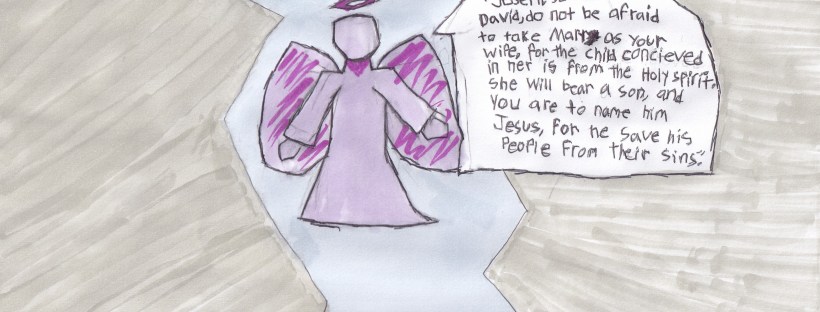
Now the birth of Jesus the Messiah took place in this way. When his mother Mary had been engaged to Joseph, but before they lived together, she was found to be with child from the Holy Spirit. Her husband Joseph, being a righteous man and unwilling to expose her to public disgrace, planned to dismiss her quietly. But just when he had resolved to do this, an angel of the Lord appeared to him in a dream and said, “Joseph, son of David, do not be afraid to take Mary as your wife, for the child conceived in her is from the Holy Spirit. She will bear a son, and you are to name him Jesus, for he will save his people from their sins.” All this took place to fulfill what had been spoken by the Lord through the prophet: “Look, the virgin shall conceive and bear a son, and they shall name him Emmanuel,” which means, “God is with us.” When Joseph awoke from sleep, he did as the angel of the Lord commanded him; he took her as his wife, but had no marital relations with her until she had borne a son; and he named him Jesus.

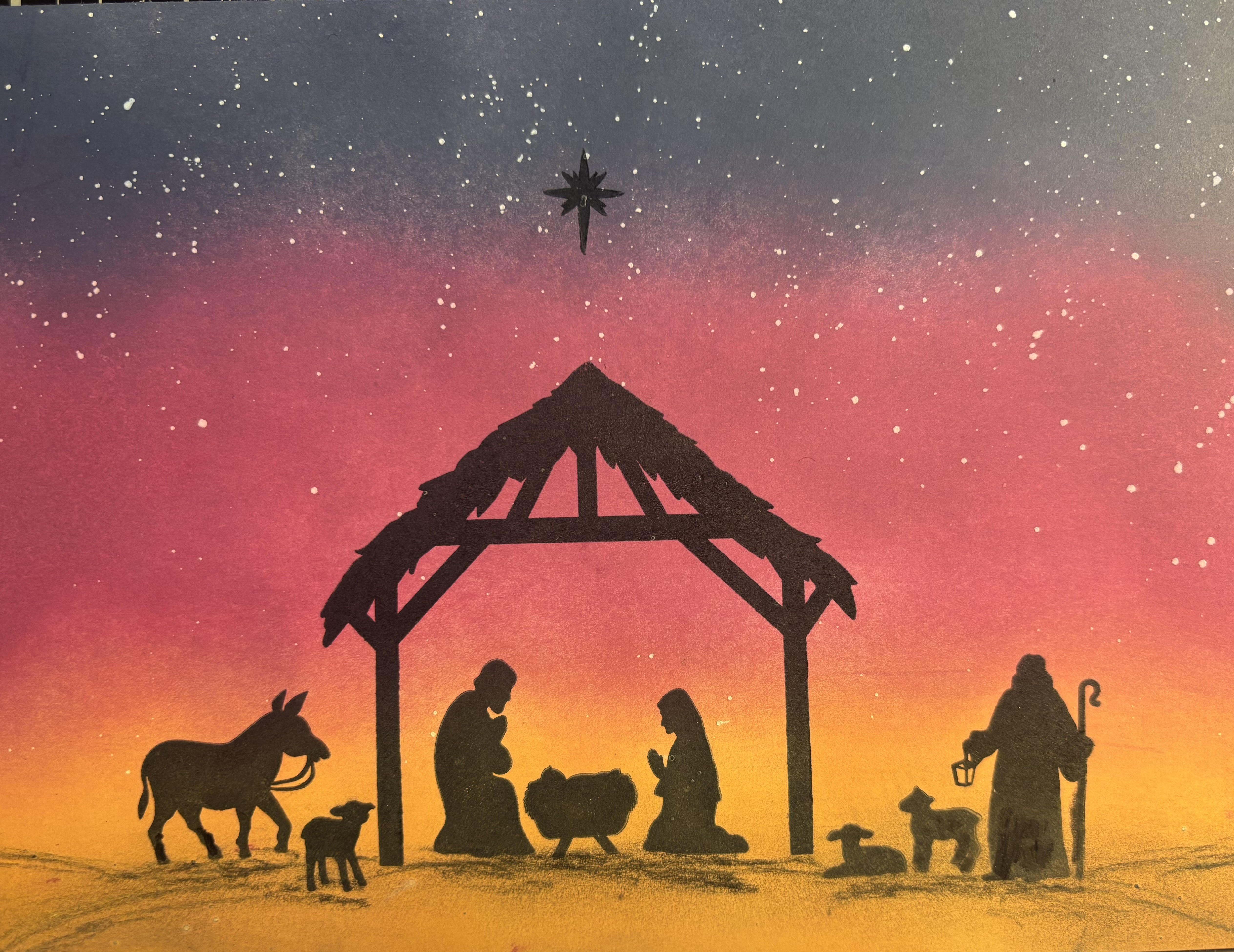
Art by Julia Gordon.

Reflect

By Donald Gordon

I feel for Joseph in this passage and can empathize with the thoughts and hurt feelings that must have been in his head. He had grown up, listened to his elders, became respected in the community, and was ready for the next step in adulthood. Joseph is described in the KJV as “just” and “upright” and in the NRSV as “righteous.” He was an honorable man. Joseph was the type of person we would all be lucky to marry or have our children be married to.

Then, life took a turn. Joseph learns that his fiancé Mary is with child. One second, he’s thinking about his new bride and life and starting a family, and the next second he’s trying to wrap his head around receiving what he thought was “bad news.” Being the honorable man that he is, Joseph does not lash out at Mary’s family or seek to shame her publicly. Instead, he looks to do the honorable thing and handle the issue privately.

How do you think Joseph got through this dilemma? What should we do when confronted with what appears to be horrible, life-altering news? Pray. I’m sure Joseph prayed and probably sought God’s strength to help him through the next steps. God hears our prayers. In Joseph’s case, God didn’t give him strength to hide the news, but an angel told Joseph to follow through with his marriage because of the “good news” of the growing son in Mary’s belly who we will all come to know as Jesus.

When life comes too fast, slow down and take a moment to pray and connect with God to hear what to do next—and possibly be part of a miracle.

Listen

By Dr. Ben Hutchens

Westminster’s Youth Handbell Choir, Jubilate Ringers, provides this week’s musical devotion, American composer Cynthia Dobrinski’s handbell setting of “Ding! Dong! Merrily on High.”  In it you will find a vibrant and rhythmically engaging treatment of the familiar French carol, designed to showcase the brilliance and agility of the handbell ensemble. Dobrinski capitalizes on the tune’s natural exuberance through crisp articulation, buoyant tempos, and sparkling bell techniques that mirror the pealing joy suggested by the text. The well-known “Gloria” refrain is especially effective, often marked by energetic ringing patterns and layered textures that create the sonic impression of bells ringing across a festive landscape.

“Ding! Dong! Merrily on High” is rooted in much earlier musical material than its familiar English text suggests. The melody comes from a 16th-century French dance tune known as “Branle de l’Official.” This lively triple-meter tune was originally secular, intended for social dancing, but its buoyant character and repeated phrases made it well suited for later adaptation as a carol melody.

The English words most commonly sung today were written by George Ratcliffe Woodward and published in 1924 in The Cambridge Carol Book. Woodward paired his newly written text—rich in medieval imagery and Latin refrains such as “Gloria in excelsis Deo”—with the Renaissance tune, transforming it into a Christmas carol celebrating the angelic announcement of Christ’s birth. This combination of a Renaissance dance melody and early 20th-century text exemplifies the revivalist interest in early music and carol traditions that shaped much of the modern English carol repertoire.

On this final week of advent, I pray that the music we offer lifts your spirits. May the peace of the Christchild and the joy of the angels be with you this week and always. 

Third Sunday of Advent – December 14

The Word

Isaiah 35:1-10

The wilderness and the dry land shall be glad, the desert shall rejoice and blossom; like the crocus it shall blossom abundantly, and rejoice with joy and singing. The glory of Lebanon shall be given to it, the majesty of Carmel and Sharon. They shall see the glory of the Lord, the majesty of our God. Strengthen the weak hands, and make firm the feeble knees. Say to those who are of a fearful heart, “Be strong, do not fear! Here is your God. He will come with vengeance, with terrible recompense. He will come and save you.”

Then the eyes of the blind shall be opened, and the ears of the deaf unstopped; then the lame shall leap like a deer, and the tongue of the speechless sing for joy. For waters shall break forth in the wilderness, and streams in the desert; the burning sand shall become a pool, and the thirsty ground springs of water; the haunt of jackals shall become a swamp, the grass shall become reeds and rushes. A highway shall be there, and it shall be called the Holy Way; the unclean shall not travel on it, but it shall be for God’s people; no traveler, not even fools, shall go astray. No lion shall be there, nor shall any ravenous beast come up on it; they shall not be found there, but the redeemed shall walk there. And the ransomed of the Lord shall return, and come to Zion with singing; everlasting joy shall be upon their heads; they shall obtain joy and gladness, and sorrow and sighing shall flee away.

Photo by Tara West.

Reflect

By Tara West

Isaiah 35:1-10 is a passage that focuses on the presence of light in darkness. This text is a reassurance to the Judahite exiles that, despite the bleak nature of their situation, there are better things to come. To the Judahite exiles, there seemed to be no redemption for their lives, but God promised them a better world.

This can apply to our lives as well, in the sense that there’s always a light at the end of the tunnel. Sometimes, in the middle of a busy week or a stressful holiday season, we lose sight of the joy in our everyday lives. But just as God promised his people a better future in this passage, that promise also applies to us. Even if there’s no big moment where everything in our life changes immediately, there’s always joy to be found if we look hard enough.

Every week in youth formation, we talk about the highs and lows of our week. This is a tiny exercise, but it encourages us to think positively about our week. We can accept (and even complain about) the bad parts of our lives, but we also have to find something good to talk about, even if it’s felt like an awful week. Sometimes the way that God shows up in our lives is through the little things, like a pretty sunset or someone complimenting your outfit.

So I challenge you, rather than focusing on the bad thing, find at least one thing every week that brings you joy, and try to focus on that joy.

Listen

By Dr. Ben Hutchens

American composer Earlene Rentz provides us with the music for this week. The recording comes from Westminster’s Advent Lessons & Carols service, featuring vocal and handbell choirs of Adults and Youth. “Arise and Shine” is a vibrant choral work rooted in the prophetic imagery of Isaiah. The anthem brings forward the theme of illumination—both divine and personal—through bright melodic gestures and clear harmonic writing. Rentz’s skillful use of parallel motion, gentle syncopation, and text-sensitive phrasing creates an atmosphere of joyful proclamation, making the piece engaging for singers and immediately appealing to listeners.

I find it difficult for any listener (or performer) to not find an immediate sense of joy! So, on this Sunday of “Joy,” I pray you might find yourself tapping you foot or even swaying along with the ringers and singers as we prepare for the great Joy of the Nativity of the Christ Child.

Second Sunday of Advent – December 7

The Word

Mathew 3:1-12

In those days John the Baptist appeared in the wilderness of Judea, proclaiming, “Repent, for the kingdom of heaven has come near.” This is the one of whom the prophet Isaiah spoke when he said, “The voice of one crying out in the wilderness: ‘Prepare the way of the Lord, make his paths straight.’” Now John wore clothing of camel’s hair with a leather belt around his waist, and his food was locusts and wild honey. Then the people of Jerusalem and all Judea were going out to him, and all the region along the Jordan, and they were baptized by him in the river Jordan, confessing their sins.

But when he saw many Pharisees and Sadducees coming for baptism, he said to them, “You brood of vipers! Who warned you to flee from the wrath to come? Bear fruit worthy of repentance. Do not presume to say to yourselves, ‘We have Abraham as our ancestor’; for I tell you, God is able from these stones to raise up children to Abraham. Even now the ax is lying at the root of the trees; every tree therefore that does not bear good fruit is cut down and thrown into the fire. “I baptize you with water for repentance, but one who is more powerful than I is coming after me; I am not worthy to carry his sandals. He will baptize you with the Holy Spirit and fire. His winnowing fork is in his hand, and he will clear his threshing floor and will gather his wheat into the granary; but the chaff he will burn with unquenchable fire.”

Scott, Lorenzo. Baptism of Jesus, from Art in the Christian Tradition, a project of the Vanderbilt Divinity Library, Nashville, TN. https://diglib.library.vanderbilt.edu/act-imagelink.pl?RC=56877 [retrieved September 17, 2023]. Original source: https://americanart.si.edu/artwork/baptism-jesus-33953.

Reflect

By Anne Soens

Advent literally means “the arrival of a person or the beginning of an event.” Advent, for Christians, begins the four Sundays prior to Christmas, the coming of Jesus, the Messiah. That is, Advent is the season in which we anticipate the joyful celebration of the birth of Jesus Christ.

The Hebrew Bible contains many predictions of the coming of Messiah, from Genesis 3:15 through the prophesies of Isaiah and Malachi. Isaiah specifically tells of a herald announcing the coming of the kingdom of God.

During the Second Temple period (576 BCE-70 CE), in particular, the Jewish people hoped for a better future and the coming of a king to usher in in a new age. Many believed that Elijah would return to be king of Israel. That’s why Jews still pour a cup of wine for Elijah during the Passover seder. Serving Elijah at the seder symbolizes hope for redemption and the coming of the Messiah.

When John the Baptist appeared in the wilderness of Judea, many believed that he fulfilled the prophecy of Isaiah 40:3, heralding the approach of the kingdom of heaven (that is, of God), the coming of the Messiah.

John’s attire of camel’s hair and a leather belt called to mind Elijah, as described in 2 Kings 1:8. John’s diet of locusts and wild honey, like his garments, was that of an ascetic, again recalling Elijah. While there is some belief that the locusts were really carob pods, locusts were actually among the few insects that were not considered unclean (Leviticus 11:20-23).

From Isaiah and the other prophets, the Jewish people knew of the idea that someone would herald the coming of Messiah. Thus, it was not surprising that many from Jerusalem and Judea came to John to confess their sins and to be baptized in the Jordan River, seeking redemption.

Even some of the religious leaders, Pharisees and Sadducees, came to John to be baptized, but John refused them. John accused them of hypocrisy by relying on their descent from Moses rather than confessing their sins and truly repenting.

Because John was only the herald of the Messiah, not the Messiah himself, John told the people that the one coming was much greater than he was. John baptized with water but prophesied that the one to come would baptize with the Holy Spirit. The one coming would separate the wheat from the chaff on the threshing floor and the chaff would burn with unquenchable fire.

John called for repentance. He refused to baptize the religious leaders because he believed they were not truly repentant but instead relied on their ancestry for justification. John preached that the kingdom of heaven was coming and that this coming required true repentance.

During this season of Advent we can reflect on the meaning of repentance. We might think of Jesus’ instruction to a woman caught in adultery, John 7:53-58. Jesus told the woman to go and sin no more. That is, turn away from the sinful behavior.

Repentance is more than confessing our transgressions and receiving forgiveness. Repentance requires turning away from sinful behavior entirely. Repentance requires changing our behavior and/or attitudes.

John prepared the way of the Lord, prophesying that the kingdom of heaven was near. During this time of awaiting Jesus’ birth, may we reflect on the meaning of repentance as we anticipate the coming of Jesus, the Messiah, and the joy of Christmas.

Listen

By Dr. Ben Hutchens

“Light One Candle to Watch for Messiah,” written by Wayne L. Wold, is a contemporary Advent hymn that beautifully captures the season’s themes of anticipation and preparation. Structured around the lighting of the Advent wreath, each stanza marks a growing sense of expectancy as another candle is kindled. The text is intentionally simple and declarative, inviting singers of all ages to participate in the unfolding journey toward Christ’s coming. Its refrain-like strophic form mirrors the weekly rhythm of Advent worship, making the hymn especially fitting for congregations that incorporate candle lighting as a central liturgical action.

Musically, the tune, ancient Hebrew in origin, is gentle and lilting. This creates an atmosphere of quiet hope that suits the reflective character of early Advent. The melody rises subtly across phrases, symbolizing the increasing light that breaks into darkness as Christmas approaches. Combined with its accessible text, the hymn becomes both a teaching tool and a devotional practice, helping worshipers internalize the Advent message of watchfulness, repentance, and joyful expectation.

First Sunday of Advent – November 30

The Word

Isaiah 2:1-5

The word that Isaiah son of Amoz saw concerning Judah and Jerusalem.

In days to come the mountain of the Lord’s house shall be established as the highest of the mountains, and shall be raised above the hills; all the nations shall stream to it. Many peoples shall come and say, “Come, let us go up to the mountain of the Lord, to the house of the God of Jacob; that he may teach us his ways and that we may walk in his paths.” For out of Zion shall go forth instruction, and the word of the Lord from Jerusalem. He shall judge between the nations, and shall arbitrate for many peoples; they shall beat their swords into plowshares, and their spears into pruning hooks; nation shall not lift up sword against nation, neither shall they learn war any more. O house of Jacob, come, let us walk in the light of the Lord!

Vuchetich, Evgeniy Viktorovich, 1908-1974. “Let us Beat Swords into Plowshares” at the United Nations north garden area, from Art in the Christian Tradition, a project of the Vanderbilt Divinity Library, Nashville, TN.
https://diglib.library.vanderbilt.edu/act-imagelink.pl?RC=52961 [retrieved May 26, 2025]. Original source: https://www.un.org/ungifts/let-us-beat-swords-ploughshares.

Reflect

By Christine Hershey, Director of Seniors Ministries

When we think of Advent, and waiting for new life, meaning and redemption to arise in the form of Christ’s birth, we already know the ending. We know the next steps, and what they are. The mystery has been taken away, to some degree. 

When we read the words of this Scripture passage, however, we don’t have that advantage. Because these words have been written by the prophet Isaiah, we have to imagine that we are still within the mystery. The events Isaiah foretold haven’t happened yet. 

And how do we have open eyes and hearts and ears and minds and bodies to hear the truth of these words? Isaiah’s prophecy seems somewhat ludicrous to those of us living in the 21st century.  Chapter 2, verse 4 says, “He (the Lord) shall judge between the nations and shall arbitrate for many peoples; they shall beat their swords into plowshares and their spears into pruning hooks; nation shall not lift up sword against nation, neither shall they learn war anymore.”

These words illuminate peace to a degree which can seem as distant as the heavenly realms twinkling far away in the night sky. And yet this is the vision which the prophet sees for the future of God’s people being with God on God’s mountain top. 

So how can we believe and pray and rest in this world of peace and reconciliation, which seems so impossible to imagine? By remembering the incredible story of a babe being born in a stable, surrounded by animals, with ripe odor emanating from all around them. And at the heart of this story of a babe come to earth in human form to redeem… Love. 

Love that makes no sense, and that is full of mercy and grace. Love that sees redemption through a child’s eyes and a mother’s heart. Love that believes and rejoices in the impossible. 

It’s as simple and as complex as that, and as mysterious and unknowing. All nations and people living and loving into a new world of peace and promise and restitution. All nations coming together to be made new. 

Prayer: God of peace and love, and God of all nations, remember us as we struggle to believe in a world and a way which is beyond our imagination and vision. Fill our eyes and ears, and our hearts and minds with the ability to envision the unimaginable. Whatever is blocking our vision in seeing a new and better way, both now and in the future, awaken and enlighten us. Prepare us to receive you and your love in brand new ways. Amen. 

Listen

By Dr. Ben Hutchens

While there are many carols and anthems that help us “get ready” for the great festival of Christmas, this setting of the words of the prophet always warms my heart. The promise of the Peaceable Kingdom of God provides a clear sense of hope and calm in the midst of a very hectic season. The recording is of our own children and adult choirs from 2019.  On advent 2, Dec 7, 2025, we will present the same at church in our annual celebration of Advent Lessons & Carols.

A shoot shall come forth out of Jesse,
And a bud shall grow out of his roots.
The spirit of life shall be with him,
The spirit of wisdom and truth.

From out of the wells of salvation
Will he draw us the water of life;
His waist shall be girdled with justice,
The heart of his heart shall be Love.

He’ll come from the end of his heaven,
And the earth shall be torn from its place;
Our lives shall be filled with his radiance
As floodwaters cover the sea.

Refrain:
Then the lamb shall lie down with the leopard,
And the lion eat straw with the ox,
For the hand of a Child shall lead them
To the peaceable kingdom of God.

It is the words of the refrain that are most meaningful to me. May the voices of the children of Westminster remind us all of the promise foretold by the prophet Isaiah as our prayers for peace and concord ascend to the throne of heaven.

Christmas Eve 2024 – December 24

The Word

Luke 2:1-14

In those days a decree went out from Emperor Augustus that all the world should be registered. This was the first registration and was taken while Quirinius was governor of Syria. All went to their own towns to be registered. Joseph also went from the town of Nazareth in Galilee to Judea, to the city of David called Bethlehem, because he was descended from the house and family of David. He went to be registered with Mary, to whom he was engaged and who was expecting a child. While they were there, the time came for her to deliver her child. And she gave birth to her firstborn son and wrapped him in bands of cloth, and laid him in a manger, because there was no place for them in the inn.

In that region there were shepherds living in the fields, keeping watch over their flock by night. Then an angel of the Lord stood before them, and the glory of the Lord shone around them, and they were terrified. But the angel said to them, “Do not be afraid; for see—I am bringing you good news of great joy for all the people: to you is born this day in the city of David a Savior, who is the Messiah, the Lord. This will be a sign for you: you will find a child wrapped in bands of cloth and lying in a manger.” And suddenly there was with the angel a multitude of the heavenly host, praising God and saying, “Glory to God in the highest heaven, and on earth peace among those whom he favors!”

Cover: Hofheinz-Döring, Margret. Holy Family, water color, 35×50 cm, WV·Nr.5834. 1973. Galerie Brigitte Mauch Göppingen. https://commons.wikimedia.org/wiki/File:Stern_von_Bethlehem,_Margret_Hofheinz-D%C3%B6ring,_Aquarell1973_(WV-Nr.5834).jpg

Reflect

By Rev. Dr. Larry Hayward

I recently read a sermon from a youth minister in another state, named John Weicher, who said,

God so loved the world that God had to love it from the inside, as one of us, instead of from the outside, as a deity…It is a lot easier to love things, people, the world, from afar. From a reasonable distance. From a place where we can stay clean and undisturbed. From the other side of Heaven. But that is not how Jesus was sent to love the world…

Weicher wrote these words about the Gospel of John and the appearance of Jesus to Doubting Thomas. But they jumped out at me about the pastoral and romantic beauty of the Nativity Scene in Luke.

We hear Luke’s story through the heavenly aura surrounding it: angels, shepherds, the Holy Family. It is indeed a story of beauty. But part of the beauty is the precise “insider nature” of the story: “A decree from Emperor Augustus.” “Quirinius was governor of Syria.” “All went to their own towns to be registered.” Then, even more personal “insider” details emerge: “firstborn son,” “wrapped in bands of cloth,” “lying in a manger.” And perhaps most of all: “No room in the inn.”

In the pastoral beauty of the story, it is easy to overlook that this is none other than the “Deity,” the God we worship, coming completely “to the inside” of our world and loving us “from the inside.” This is not a God who loves us “from afar… a reasonable distance… clean and undisturbed.” God loves us “from the inside.”

Many of us are drawn to Christmas services because we implicitly know that they connect us – in fact, draw forth from us – that which is deepest inside us: our joys and sorrows, our successes and setbacks, indeed, our “hopes and fears of all the years.” It is because God in Christ comes “inside” that we open what is inside us to him. Once we do that, it is the start of our being able to love the world Christ came to redeem, starting with the life and people nearest to us.

Prayer: On this night, O Lord, from your inside draw us outward to you and others. Amen.

Listen

By Dr. Ben Hutchens

A Live Recording from Westminster’s Service of Advent Lessons & Carols 2024

The Westminster choir sings for us Distler’s setting of the beloved carol, “Lo! How a Rose E’er Blooming.” Hugo Distler (1908–1942) was a German composer and organist renowned for his contributions to sacred choral music during the early 20th century. Deeply influenced by the music of Johann Sebastian Bach and the polyphonic traditions of the Renaissance, Distler developed a distinctive style characterized by intricate counterpoint, rhythmic vitality, and modern harmonic language. His works often reflect the liturgical and spiritual contexts of his Lutheran faith, as seen in compositions like Die Weihnachtsgeschichte (The Christmas Story). Tragically, Distler’s life was cut short at the age of 34, a victim of the harsh realities and pressures of living under the Nazi regime, which condemned his music as “degenerate.” Despite his untimely death, his works remain a vital part of the repertoire, celebrated for their emotional depth and innovative synthesis of old and new musical traditions.

One of Distler’s notable contributions to the choral canon is his arrangement of “Es ist ein Ros entsprungen” (“Lo, How a Rose E’er Blooming”), a traditional German hymn dating back to the late 16th century. Distler’s version retains the serene beauty and meditative quality of the original melody while infusing it with his characteristic harmonic intricacy and expressiveness. The hymn, associated with the Advent and Christmas seasons, reflects on the birth of Christ as a fulfillment of divine prophecy, symbolized by the blooming rose. Distler’s treatment of the hymn highlights his ability to honor the historical roots of a piece while bringing it into the context of modern sacred music, creating a timeless work that continues to inspire performers and listeners alike.

Fourth Sunday of Advent – December 22

The Word

Micah 5:2-5

But you, O Bethlehem of Ephrathah, who are one of the little clans of Judah, from you shall come forth for me one who is to rule in Israel, whose origin is from of old, from ancient days. Therefore he shall give them up until the time when she who is in labor has brought forth; then the rest of his kindred shall return to the people of Israel. And he shall stand and feed his flock in the strength of the Lord, in the majesty of the name of the Lord his God. And they shall live secure, for now he shall be great to the ends of the earth; and he shall be the one of peace. If the Assyrians come into our land and tread upon our soil, we will raise against them seven shepherds and eight installed as rulers.

JESUS MAFA. The birth of Jesus with shepherds, from Art in the Christian Tradition, a project of the Vanderbilt Divinity Library, Nashville, TN. https://diglib.library.vanderbilt.edu/act-imagelink.pl?RC=48387 [retrieved June 16, 2024]. Original source: http://www.librairie-emmanuel.fr (contact page: https://www.librairie-emmanuel.fr/contact).

Reflect

By Melynda Wilcox

Small-town boy makes good in the big city and puts his village on the map—the stuff of books and movie scripts. And that’s the scene that the prophet Micah sets in chapter 5, verse 2, as he foretells that Bethlehem, despite being one of the smallest clans in all of Judah, will be the birthplace of the Messiah. Some translations of this verse imply that Bethlehem is too small even to be considered a clan of Judah—barely big enough to warrant a stop sign let alone a stoplight at the crossroads. And with its small size, Bethlehem is unlikely to have been of any consequence in the geopolitics of antiquity.

Once again, God returns to the recurring Biblical theme of choosing the least likely person from the least significant place to advance God’s purposes in the world. In this backwater hamlet, of all places, a baby born to a young unmarried girl will become the messenger of God’s salvation, “the one of peace.” Bethlehem will be forever changed. The world will be forever changed.

The tradition of miniature nativity scenes, which began more than 1,500 years ago as a way to give ordinary people—who lived miles away from a church—access to the divine, is evocative of Micah’s description of Bethlehem. Retablos made in Central and South America were designed inside small boxes with hinges and latches so that they would be portable for traveling priests. Hollowed-out walnut shells and gourds are also popular containers for small manger scenes. The Washington National Cathedral has a nativity scene that is painted on the head of a pin among its impressive collection of crèches. The miniature world of the nativity, beautiful but fragile in its diminutive form, transports us back to a tiny place called Bethlehem.

As the journey to Bethlehem unfolds, pause to observe more closely—and perhaps more patiently—the small or seemingly inconsequential occurrences in daily life: the curious insect on the windowsill, the unusual shape of a cloud, the trajectory of a falling leaf, the strangers you pass in the frozen food aisle, the smiles between a mother and child from across the waiting room. Take a moment to think of Bethlehem.

Listen

By Dr. Ben Hutchens

A Live Recording from Westminster’s Service of Advent Lessons & Carols 2024

The Children (and congregation) of Westminster lead us in this week’s devotion. The Advent wreath is a Christian tradition that symbolizes the passage of the four weeks leading up to Christmas. Typically made from evergreen branches, the circular shape of the wreath represents eternity and the everlasting nature of God’s love. Four candles are placed around the wreath, with a fifth candle often positioned in the center. Each candle is lit successively on the Sundays of Advent, representing the growing anticipation of Christ’s coming as the Light of the World. The colors of the candles— three purple and one pink—reflect themes of penance, preparation, and joy. The pink candle, lit on the third Sunday, symbolizes Gaudete Sunday, a moment of rejoicing in the midst of Advent’s reflective tone.

The center candle is the Christ Candle, traditionally white and lit on Christmas Eve or Christmas Day to celebrate the birth of Jesus. Each week, the lighting of a new candle is often accompanied by Scripture readings, prayers, and hymns, creating a ritual that fosters reflection and community. Beyond its liturgical significance, the Advent wreath has become a cherished tradition in homes and churches alike, offering a tangible reminder of hope, peace, joy, and love—the key themes of the season. Its simplicity and profound symbolism make it a meaningful centerpiece of Advent worship and devotion.

Third Sunday of Advent – December 15

The Word

Luke 3:15-18

As the people were filled with expectation, and all were questioning in their hearts concerning John, whether he might be the Messiah, John answered all of them by saying, “I baptize you with water; but one who is more powerful than I is coming; I am not worthy to untie the thong of his sandals. He will baptize you with the Holy Spirit and fire. His winnowing fork is in his hand, to clear his threshing floor and to gather the wheat into his granary; but the chaff he will burn with unquenchable fire.” So, with many other exhortations, he proclaimed the good news to the people.

JESUS MAFA. John the Baptist preaching in the desert, from Art in the Christian Tradition, a project of the Vanderbilt Divinity Library, Nashville, TN. https://diglib.library.vanderbilt.edu/act-imagelink.pl?RC=48386 [retrieved June 16, 2024]. Original source: http://www.librairie-emmanuel.fr (contact page: https://www.librairie-emmanuel.fr/contact).

Reflect

By Sam Gunter

At the very start of this verse, the people question John, asking whether he was the one they had been waiting for, the Messiah. He gives them a resolute “no,” saying that he was unworthy to even serve Jesus. He says that Jesus is great and powerful, and all John can do is baptize.

Many of us can relate to this. In the season of Advent, we may feel like we have to be on top of everything going into vacation, we need to have bought all the presents and sent out all the cards. But, like John, we’re not Jesus. We can’t do everything. Even a straight-A student will miss a few deadlines or forget about something every now and then.

Knowing that we can’t be on top of things, there are still some things we can do. Like John, we can proclaim the good news. We can encourage others to be on top of their projects. We can spread Christmas cheer. We can spread the word of the Lord, and help others. This is a very important role, and is vital in this stressful season. We can’t do it all, but we still have to help others and spread good news. If everyone did that, think of how much better this season could be. In the coming weeks, try to remember: you can’t do everything, but you can at least help others.

Listen

By Dr. Ben Hutchens

A Live Recording from Westminster’s Service of Advent Lessons & Carols 2024

Westminster’s Youth Handbell Choir, Jubilate Ringers, provide the music for this week. The piece “Advent Joy” includes two familiar and beloved hymn tunes. 

HYFRYDOL is a beloved Welsh hymn tune, composed by Rowland Huw Prichard in 1830 when he was just 20 years old. Its name, meaning “cheerful” in Welsh, aptly reflects its uplifting and lyrical character. HYFRYDOL is noted for its smooth, flowing melody, making it an enduring favorite in hymnody. The tune is most commonly associated with Charles Wesley’s text “Love Divine, All Loves Excelling,” though it has also been paired with other texts, such as “Come, Thou Long-Expected Jesus.” Its adaptable nature and emotional depth have cemented its place in Christian worship across denominational lines. 

BEREDEN VÄG FÖR HERRAN, meaning “Prepare the Way for the Lord” in Swedish, is a hymn tune associated with Advent and the anticipation of Christ’s coming. The melody originates from a Swedish folk tune and is traditionally linked to the text by Frans Mikael Franzén, a Swedish bishop and poet. The tune carries a regal and processional quality, evoking the sense of joy and preparation central to the Advent season. Its clear, ascending lines and steady rhythm reflect the theme of spiritual readiness and celebration. While it is deeply rooted in Scandinavian liturgical traditions, BEREDEN VÄG FÖR HERRAN has also found its place in broader Christian worship, offering a melodic glimpse of the anticipation and hope that characterize the weeks leading up to Christmas.

Second Sunday of Advent – December 8

The Word

Malachi 3:1-4

See, I am sending my messenger to prepare the way before me, and the Lord whom you seek will suddenly come to his temple. The messenger of the covenant in whom you delight—indeed, he is coming, says the Lord of hosts. But who can endure the day of his coming, and who can stand when he appears? For he is like a refiner’s fire and like fullers’ soap; he will sit as a refiner and purifier of silver, and he will purify the descendants of Levi and refine them like gold and silver, until they present offerings to the Lord in righteousness. Then the offering of Judah and Jerusalem will be pleasing to the Lord as in the days of old and as in former years.

Pieter Brueghel the Elder. The Sermon of Saint John the Baptist. 1566. Oil on oak. Museum of Fine Arts, Budapest. https://commons.wikimedia.org/.

Reflect

By Adrienne Griffin

Malachi is the last book of the grouping known as the 12 minor prophets; in fact, it is the last book of the Old Testament. So it seems fitting that we read it at the end of the calendar year. But Advent is the first part of the liturgical year, and it emphasizes newness and beginnings. Most scholars believe that the book was written by one person, whose name may or may have not been Malachi, which means “Messenger” in Hebrew. This Messenger was likely speaking to Israel after it had returned from exile because the text uses a word for “governor” that dates from the Persian period of Israel’s history. The whole book is organized into a series of situations or subjects about which, the Messenger declares, God is not pleased—at all. Hey, don’t shoot the messenger, one can imagine our Malachi protesting.

In chapter 3, the message is that God is sending a messenger to prepare the way. And after that preparation the Lord will “suddenly come to his temple.” I must admit that when I first read this selection, I had a lot of questions. For one thing I lose track of who is coming – the messenger or the Lord? Is the message a bad one, if we cannot stand when he appears or even endure the day of his coming? Isn’t this part of the Messiah?

One interpretation of Malachi, according to some commentary, is that the prophet needed to explain to the Israelites why their post-exile lives were not better. Although the temple had been rebuilt, some practices were corrupt and many seemed to have forgotten their covenant with God. Later in chapter 3, Malachi speaks of bearing witness against many, including those who swear falsely, those who oppress the hired workers in their wages, and those who thrust aside the alien.

Although it sounds difficult and possibly painful to be refined with fire or like fullers’ soap, the text does say that the descendants of Levi are going to be refined like silver and gold, which to me means that the people are precious metals underneath the things that cause them to need purifying. In another part of chapter 3, God reminds them in this way: “For I the Lord do not change; therefore you, O children of Jacob, have not perished. Ever since the days of your ancestors you have turned aside from my statutes and have not kept them. Return to me, and I will return to you, says the Lord of hosts.”

As Christians, we can also read this part of Malachi as a precursor of John preparing the way for Jesus. John called for repentance before baptism, and although he baptized with water, he recognized that Jesus would baptize with fire, and with the Holy Spirit. I don’t particularly look forward to being refined, but I do think Advent is a good time to think about what needs some changing or polishing in my own life. That thought process and resulting actions might not be easy, but because we’re moving together toward the nativity, I know the ending is good. When I think about the new beginning Christ’s coming always offers, I understand Malachi’s question—“who can stand when he appears?”—as an exclamation of wonder and awe.

Listen

By Dr. Ben Hutchens

A Live Recording from Westminster’s Service of Advent Lessons & Carols 2023

“O Come, O Come, Emmanuel” is a beloved Advent hymn that originates from the early medieval period, associated with the liturgy of the Catholic Church. The carol is a paraphrase of the “O Antiphons,” which are ancient chants that date back to the 8th century and are recited in the days leading up to Christmas. The song’s haunting melody and poignant lyrics evoke a deep sense of longing and anticipation for the coming of Christ. The verses speak not only to the historical expectation of the Messiah but resonate with the universal theme of hope, especially during challenging times. Each verse addresses Emmanuel, a name meaning “God with us,” highlighting different aspects of His promised salvation.

The structure of the hymn encourages reflection, as the repetition of the phrases creates a sense of building urgency and yearning. With each invocation of “O come,” the faithful are reminded of the need for divine presence and intervention in their lives and the world. The imagery in the lyrics draws from the rich tapestry of biblical prophecy, incorporating themes of liberation from darkness, the restoration of joy, and the coming of peace. As a centerpiece of Advent celebrations, “O Come, O Come, Emmanuel” invites congregations to unite in prayerful anticipation, bridging the gap between the historical and the modern-day longing for hope and redemption.

First Sunday of Advent – December 1

The Word

Jeremiah 33:14-16

The days are surely coming, says the Lord, when I will fulfill the promise I made to the house of Israel and the house of Judah. In those days and at that time I will cause a righteous Branch to spring up for David; and he shall execute justice and righteousness in the land. In those days Judah will be saved and Jerusalem will live in safety. And this is the name by which it will be called: “The Lord is our righteousness.”

Brooke, Richard Norris, 1847-1920. Pastoral Visit, Virginia, from Art in the Christian Tradition, a project of the Vanderbilt Divinity Library, Nashville, TN. https://diglib.library.vanderbilt.edu/act-imagelink.pl?RC=57807 retrieved September 14, 2024].

Reflect

By Judy Grey

At Christmas time, my brother and I sometimes recount this story for its entertainment value. But it also shows the stark contrast between what we thought was important as spoiled young adults and what we know decades later as we await celebration of the birth of our Savior, Jesus Christ.

Following my graduation from college and my brother’s from high school, we went to Europe for a “gap” year. I went to Paris as a newly-minted French major, and he went to a school in England to “mature” before college. That Christmas, we were invited to spend Christmas in Munich by the president of my college, Dr. Sam Spencer, and his family.

Before leaving for Munich on December 23rd, my brother came to Paris so we could celebrate with friends from home. In fact, we celebrated so thoroughly that we boarded the train just as it was moving out of the station, throwing our mountains of luggage on the last car. Feeling the effects of the previous night’s revelry, we could only carry half of our luggage to our seats through the long, packed train. Once in our seats and meaning to rest a bit before retrieving our remaining luggage at the rear of the train, we fell asleep though I was aware of the train’s stops and starts. When we awoke, our walk to the back of the train was considerably shorter and once there, to the hilarity of train personnel standing by, we found the car with our luggage had been disconnected hours before in France.

Brett Sayles. Train driving along railroad. https://www.pexels.com/photo/train-driving-along-railroad-6937711/

This jolted us from our holiday making. We were mortified at the inconvenience we caused our hosts; embarrassed that we had no gifts for them and their four kids; shamed that my college president spent Christmas Eve on the phone trying to get someone to pick up. Layered on that was our irritation that we didn’t have gifts my mom had sent us and that we had to wear our hosts’ clothes, which neither fit nor were becoming. Thankfully, the story ended with finding our luggage in Frankfurt, remaining close friends with the Spencer family, and having the story of a German Christmas that remains special and unforgettable.

Reflection as adults on our inconvenience and loss that Christmas is dramatic as we observe this Christmas the serious needs of those who suffer around the world and in our own backyards. Those who will observe hungry, cold, missing loved ones, in pain, depressed, and at war. Those who wonder where God is in their despair. As Larry said in a sermon early this year – “There is something about our time that we have almost lost the ability to be hopeful about our world…We have lost faith that ‘the whole world’ is in God’s hands, especially parts near to us.”

As we celebrate Christmas in 2024, we must trust the one who was born that winter night to deliver us – the one who lay in the manger and was lifted up in crucifixion, resurrection, and ascension for the whole world. It’s about much more than finding lost luggage. It’s about the certainty that, in His time, our Savior will find us and restore peace, safety, and reconciliation to our hurting world.

Listen

By Dr. Ben Hutchens

TThe season of Advent marks a time of anticipation and preparation for the celebration of Christmas. This period lasts for four weeks leading up to Christmas Day, beginning on the fourth Sunday before December 25. Advent symbolizes hope and expectation, as congregations reflect on the profound meaning of Christ’s coming. As the church community gathers, the color purple often takes center stage, representing penitence and anticipation. 

The resonant tones of handbells add a unique layer of reverence and beauty of our services. This week, the Goodwin House Ringers bring us “Marche Royale.” This dedicated ensemble of ringers, who are residents at Goodwin House Alexandria, create a rich tapestry of sound and invite us all to engage in a deeper spiritual reflection. Each note played rings out like a prayer, connecting the hearts of the congregation to the message of the season: the promise of renewal and the joyous celebration of the impending arrival of the Christ child.

Christmas Eve – December 24

The Word

Luke 1:26-38

In the sixth month the angel Gabriel was sent by God to a town in Galilee called Nazareth, to a virgin engaged to a man whose name was Joseph, of the house of David. The virgin’s name was Mary. And he came to her and said, “Greetings, favored one! The Lord is with you.” 

But she was much perplexed by his words and pondered what sort of greeting this might be. The angel said to her, “Do not be afraid, Mary, for you have found favor with God. And now, you will conceive in your womb and bear a son, and you will name him Jesus. He will be great, and will be called the Son of the Most High, and the Lord God will give to him the throne of his ancestor David. He will reign over the house of Jacob forever, and of his kingdom there will be no end.” 

Mary said to the angel, “How can this be, since I am a virgin?” The angel said to her, “The Holy Spirit will come upon you, and the power of the Most High will overshadow you; therefore the child to be born will be holy; he will be called Son of God. And now, your relative Elizabeth in her old age has also conceived a son; and this is the sixth month for her who was said to be barren. For nothing will be impossible with God.” 

Then Mary said, “Here am I, the servant of the Lord; let it be with me according to your word.” Then the angel departed from her.

Art by Janet Hawkins.

Reflect

By Janet Hawkins

As a child, I began anticipating Christmas soon after the Sears catalogue (the size of an encyclopedia!) appeared in our mailbox in August. I would spend hours thumbing through it, folding over page edges – gentle hints to Santa, the “must have” toys on my list.

My father would bring home two stockings in October for me to fill for local children in need. I was given five dollars per stocking to purchase small gifts at the local variety store. I never knew anything about the children, but I was hopeful they accepted the stockings as a gift of love from my family.

In November, my Sunday School class assembled a “take home” Advent kit. We painted the wooden candleholders, and then the class assembled Advent booklets. I have kept those Advent books ever since, and when I was recently looking at them again, I immediately noticed someone was missing from the assigned scripture, prayers, and hymns: Mary. After Gabriel appears to Mary, there is no mention of her until Christmas Eve, when she and Joseph arrive at the stable for the birth of Jesus.

Looking for answers, I referred to my childhood Bible (the Revised Standard Version):

Gabriel said, ‘Do not be afraid, for you have found favor with God. And you will conceive in your womb a son and you shall call him Jesus…He will be great … And Mary said, ‘How can this be since I have no husband?… And Gabriel said to her, “The Holy Spirit will come upon you and the power of the most high will overshadow you.” … Mary said, “Behold: I am the handmaid of the Lord, let it be to me according to your word.” (Luke 1: 30)

In retrospect, these verses may have been difficult to explain to a grade school Sunday School class. I can’t recall Mr. White’s Luke 1 lesson, although I suspect he focused less on conception and moved on to Luke 2 (when Jesus is lying in the manger).

Today, however, I wonder about Mary. What was her reaction after being told she was going to be a mother? Mary was most likely a teenager. Surely, she had questions. Why me? Perhaps she was frightened about her future. Instead, Mary asked only one question: “How can this be?” After listening to Gabriel’s response, she answered: “Let it be.”

In my own life, “first world problems” often overwhelm me. When I am struggling, I pray and am pleasantly reminded that my faith gives me strength as well as support during difficult times or even when I ask, “why me?” By accepting that God has my back, I carry on and know I will get through whatever seems to be troubling me.

Rather than focusing on being “merry” this holiday season; let’s instead focus on “Mary.” Receiving God’s blessing, she took a leap of faith and willingly accepted her role in Christ’s birth. Mary’s faith is a gentle reminder to joyfully accept God’s gift of love – the birth of our Lord, Jesus Christ.

Listen

By Dr. Ben Hutchens

As we end our preparations for Christmas, the combined choirs of Westminster – Adults, Choristers, and Children – join in singing American composer Carolyn Jennings’ setting of “Climb to the Top of the Highest Mountain.” The season of Advent draws us and our attention to the great and mighty wonder in the coming of the Christchild; this anthem provides a music setting of the same. It begins quietly with the children’s voices. After a few minutes we are reminded of Christ’s triumphant second coming in power and glory. The anthem ends as it begins, quietly, as the youngest voices implore us to “love and trust him as a child.”  

May the peace of God be with you this Christmastide as we worship the Christchild with friends around the world, and also with those who worship with us but on another shore and in a greater light. Merry Christmas!

Climb to the top of the highest mountain, joyous tidings proclaim to the world,
Lift up your voice, shout the good news: behold, your Lord comes to you.
He will feed his flock like a shepherd, he will carry the lambs in his arms,
He will ever keep them safe from harm. Behold, your Lord comes to you.
He who made the stars in the heaven, He who fashioned the earth and the sea,
From time eternal he was God, the Alpha and Omega, he. Behold, your Lord!
He will come in power and glory, he will rule with mercy and truth,
Hope of the nations, light of all the world.
He will love the little children, he will hold them in his arms.
Love him and trust him as a little child. Behold, your Lord comes to you.