Third Sunday of Advent – December 14

The Word

Isaiah 35:1-10

The wilderness and the dry land shall be glad, the desert shall rejoice and blossom; like the crocus it shall blossom abundantly, and rejoice with joy and singing. The glory of Lebanon shall be given to it, the majesty of Carmel and Sharon. They shall see the glory of the Lord, the majesty of our God. Strengthen the weak hands, and make firm the feeble knees. Say to those who are of a fearful heart, “Be strong, do not fear! Here is your God. He will come with vengeance, with terrible recompense. He will come and save you.”

Then the eyes of the blind shall be opened, and the ears of the deaf unstopped; then the lame shall leap like a deer, and the tongue of the speechless sing for joy. For waters shall break forth in the wilderness, and streams in the desert; the burning sand shall become a pool, and the thirsty ground springs of water; the haunt of jackals shall become a swamp, the grass shall become reeds and rushes. A highway shall be there, and it shall be called the Holy Way; the unclean shall not travel on it, but it shall be for God’s people; no traveler, not even fools, shall go astray. No lion shall be there, nor shall any ravenous beast come up on it; they shall not be found there, but the redeemed shall walk there. And the ransomed of the Lord shall return, and come to Zion with singing; everlasting joy shall be upon their heads; they shall obtain joy and gladness, and sorrow and sighing shall flee away.

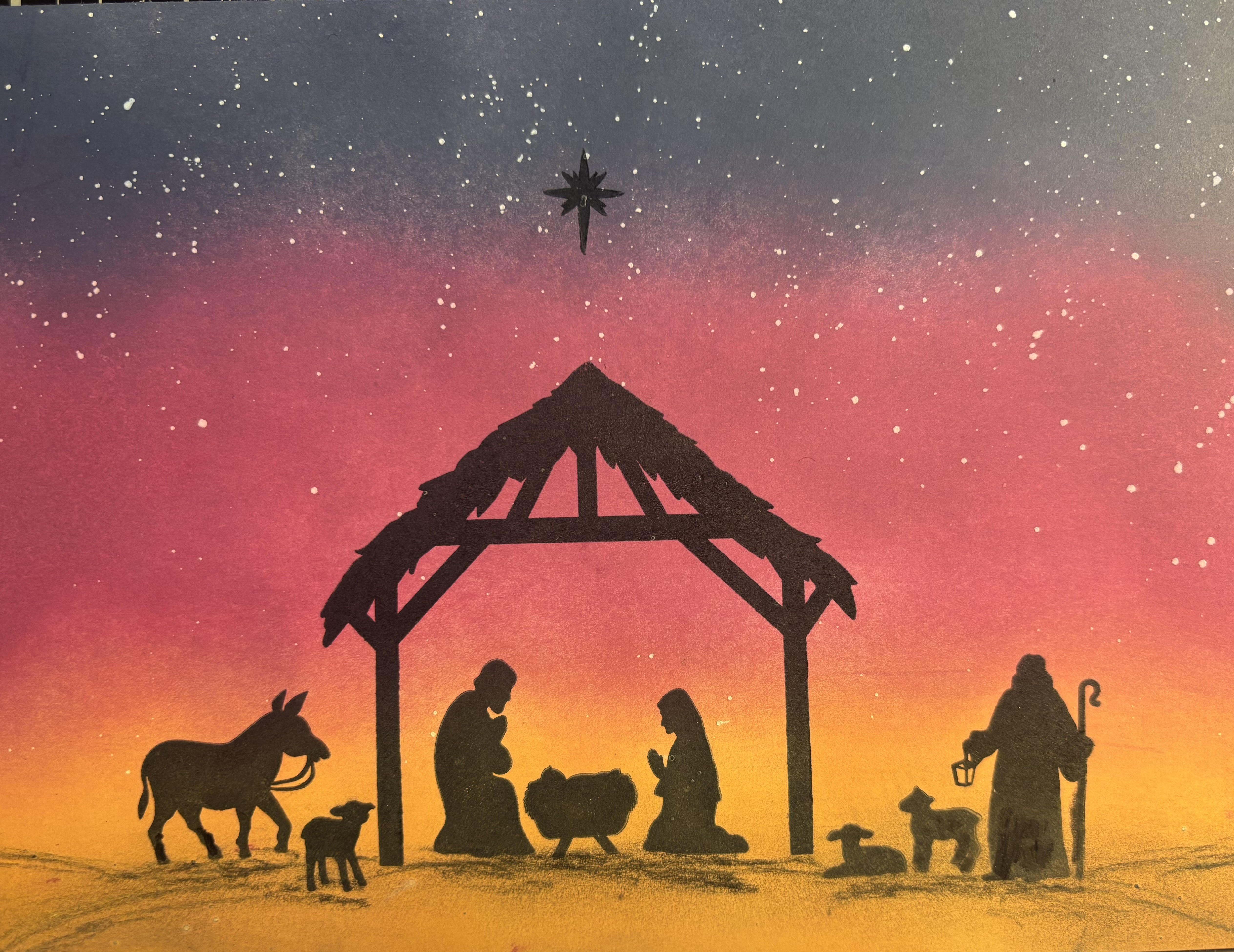
Photo by Tara West.

Reflect

By Tara West

Isaiah 35:1-10 is a passage that focuses on the presence of light in darkness. This text is a reassurance to the Judahite exiles that, despite the bleak nature of their situation, there are better things to come. To the Judahite exiles, there seemed to be no redemption for their lives, but God promised them a better world.

This can apply to our lives as well, in the sense that there’s always a light at the end of the tunnel. Sometimes, in the middle of a busy week or a stressful holiday season, we lose sight of the joy in our everyday lives. But just as God promised his people a better future in this passage, that promise also applies to us. Even if there’s no big moment where everything in our life changes immediately, there’s always joy to be found if we look hard enough.

Every week in youth formation, we talk about the highs and lows of our week. This is a tiny exercise, but it encourages us to think positively about our week. We can accept (and even complain about) the bad parts of our lives, but we also have to find something good to talk about, even if it’s felt like an awful week. Sometimes the way that God shows up in our lives is through the little things, like a pretty sunset or someone complimenting your outfit.

So I challenge you, rather than focusing on the bad thing, find at least one thing every week that brings you joy, and try to focus on that joy.

Listen

By Dr. Ben Hutchens

American composer Earlene Rentz provides us with the music for this week. The recording comes from Westminster’s Advent Lessons & Carols service, featuring vocal and handbell choirs of Adults and Youth. “Arise and Shine” is a vibrant choral work rooted in the prophetic imagery of Isaiah. The anthem brings forward the theme of illumination—both divine and personal—through bright melodic gestures and clear harmonic writing. Rentz’s skillful use of parallel motion, gentle syncopation, and text-sensitive phrasing creates an atmosphere of joyful proclamation, making the piece engaging for singers and immediately appealing to listeners.

I find it difficult for any listener (or performer) to not find an immediate sense of joy! So, on this Sunday of “Joy,” I pray you might find yourself tapping you foot or even swaying along with the ringers and singers as we prepare for the great Joy of the Nativity of the Christ Child.

Second Sunday of Advent – December 7

The Word

Mathew 3:1-12

In those days John the Baptist appeared in the wilderness of Judea, proclaiming, “Repent, for the kingdom of heaven has come near.” This is the one of whom the prophet Isaiah spoke when he said, “The voice of one crying out in the wilderness: ‘Prepare the way of the Lord, make his paths straight.’” Now John wore clothing of camel’s hair with a leather belt around his waist, and his food was locusts and wild honey. Then the people of Jerusalem and all Judea were going out to him, and all the region along the Jordan, and they were baptized by him in the river Jordan, confessing their sins.

But when he saw many Pharisees and Sadducees coming for baptism, he said to them, “You brood of vipers! Who warned you to flee from the wrath to come? Bear fruit worthy of repentance. Do not presume to say to yourselves, ‘We have Abraham as our ancestor’; for I tell you, God is able from these stones to raise up children to Abraham. Even now the ax is lying at the root of the trees; every tree therefore that does not bear good fruit is cut down and thrown into the fire. “I baptize you with water for repentance, but one who is more powerful than I is coming after me; I am not worthy to carry his sandals. He will baptize you with the Holy Spirit and fire. His winnowing fork is in his hand, and he will clear his threshing floor and will gather his wheat into the granary; but the chaff he will burn with unquenchable fire.”

Scott, Lorenzo. Baptism of Jesus, from Art in the Christian Tradition, a project of the Vanderbilt Divinity Library, Nashville, TN. https://diglib.library.vanderbilt.edu/act-imagelink.pl?RC=56877 [retrieved September 17, 2023]. Original source: https://americanart.si.edu/artwork/baptism-jesus-33953.

Reflect

By Anne Soens

Advent literally means “the arrival of a person or the beginning of an event.” Advent, for Christians, begins the four Sundays prior to Christmas, the coming of Jesus, the Messiah. That is, Advent is the season in which we anticipate the joyful celebration of the birth of Jesus Christ.

The Hebrew Bible contains many predictions of the coming of Messiah, from Genesis 3:15 through the prophesies of Isaiah and Malachi. Isaiah specifically tells of a herald announcing the coming of the kingdom of God.

During the Second Temple period (576 BCE-70 CE), in particular, the Jewish people hoped for a better future and the coming of a king to usher in in a new age. Many believed that Elijah would return to be king of Israel. That’s why Jews still pour a cup of wine for Elijah during the Passover seder. Serving Elijah at the seder symbolizes hope for redemption and the coming of the Messiah.

When John the Baptist appeared in the wilderness of Judea, many believed that he fulfilled the prophecy of Isaiah 40:3, heralding the approach of the kingdom of heaven (that is, of God), the coming of the Messiah.

John’s attire of camel’s hair and a leather belt called to mind Elijah, as described in 2 Kings 1:8. John’s diet of locusts and wild honey, like his garments, was that of an ascetic, again recalling Elijah. While there is some belief that the locusts were really carob pods, locusts were actually among the few insects that were not considered unclean (Leviticus 11:20-23).

From Isaiah and the other prophets, the Jewish people knew of the idea that someone would herald the coming of Messiah. Thus, it was not surprising that many from Jerusalem and Judea came to John to confess their sins and to be baptized in the Jordan River, seeking redemption.

Even some of the religious leaders, Pharisees and Sadducees, came to John to be baptized, but John refused them. John accused them of hypocrisy by relying on their descent from Moses rather than confessing their sins and truly repenting.

Because John was only the herald of the Messiah, not the Messiah himself, John told the people that the one coming was much greater than he was. John baptized with water but prophesied that the one to come would baptize with the Holy Spirit. The one coming would separate the wheat from the chaff on the threshing floor and the chaff would burn with unquenchable fire.

John called for repentance. He refused to baptize the religious leaders because he believed they were not truly repentant but instead relied on their ancestry for justification. John preached that the kingdom of heaven was coming and that this coming required true repentance.

During this season of Advent we can reflect on the meaning of repentance. We might think of Jesus’ instruction to a woman caught in adultery, John 7:53-58. Jesus told the woman to go and sin no more. That is, turn away from the sinful behavior.

Repentance is more than confessing our transgressions and receiving forgiveness. Repentance requires turning away from sinful behavior entirely. Repentance requires changing our behavior and/or attitudes.

John prepared the way of the Lord, prophesying that the kingdom of heaven was near. During this time of awaiting Jesus’ birth, may we reflect on the meaning of repentance as we anticipate the coming of Jesus, the Messiah, and the joy of Christmas.

Listen

By Dr. Ben Hutchens

“Light One Candle to Watch for Messiah,” written by Wayne L. Wold, is a contemporary Advent hymn that beautifully captures the season’s themes of anticipation and preparation. Structured around the lighting of the Advent wreath, each stanza marks a growing sense of expectancy as another candle is kindled. The text is intentionally simple and declarative, inviting singers of all ages to participate in the unfolding journey toward Christ’s coming. Its refrain-like strophic form mirrors the weekly rhythm of Advent worship, making the hymn especially fitting for congregations that incorporate candle lighting as a central liturgical action.

Musically, the tune, ancient Hebrew in origin, is gentle and lilting. This creates an atmosphere of quiet hope that suits the reflective character of early Advent. The melody rises subtly across phrases, symbolizing the increasing light that breaks into darkness as Christmas approaches. Combined with its accessible text, the hymn becomes both a teaching tool and a devotional practice, helping worshipers internalize the Advent message of watchfulness, repentance, and joyful expectation.

First Sunday of Advent – November 30

The Word

Isaiah 2:1-5

The word that Isaiah son of Amoz saw concerning Judah and Jerusalem.

In days to come the mountain of the Lord’s house shall be established as the highest of the mountains, and shall be raised above the hills; all the nations shall stream to it. Many peoples shall come and say, “Come, let us go up to the mountain of the Lord, to the house of the God of Jacob; that he may teach us his ways and that we may walk in his paths.” For out of Zion shall go forth instruction, and the word of the Lord from Jerusalem. He shall judge between the nations, and shall arbitrate for many peoples; they shall beat their swords into plowshares, and their spears into pruning hooks; nation shall not lift up sword against nation, neither shall they learn war any more. O house of Jacob, come, let us walk in the light of the Lord!

Vuchetich, Evgeniy Viktorovich, 1908-1974. “Let us Beat Swords into Plowshares” at the United Nations north garden area, from Art in the Christian Tradition, a project of the Vanderbilt Divinity Library, Nashville, TN.
https://diglib.library.vanderbilt.edu/act-imagelink.pl?RC=52961 [retrieved May 26, 2025]. Original source: https://www.un.org/ungifts/let-us-beat-swords-ploughshares.

Reflect

By Christine Hershey, Director of Seniors Ministries

When we think of Advent, and waiting for new life, meaning and redemption to arise in the form of Christ’s birth, we already know the ending. We know the next steps, and what they are. The mystery has been taken away, to some degree. 

When we read the words of this Scripture passage, however, we don’t have that advantage. Because these words have been written by the prophet Isaiah, we have to imagine that we are still within the mystery. The events Isaiah foretold haven’t happened yet. 

And how do we have open eyes and hearts and ears and minds and bodies to hear the truth of these words? Isaiah’s prophecy seems somewhat ludicrous to those of us living in the 21st century.  Chapter 2, verse 4 says, “He (the Lord) shall judge between the nations and shall arbitrate for many peoples; they shall beat their swords into plowshares and their spears into pruning hooks; nation shall not lift up sword against nation, neither shall they learn war anymore.”

These words illuminate peace to a degree which can seem as distant as the heavenly realms twinkling far away in the night sky. And yet this is the vision which the prophet sees for the future of God’s people being with God on God’s mountain top. 

So how can we believe and pray and rest in this world of peace and reconciliation, which seems so impossible to imagine? By remembering the incredible story of a babe being born in a stable, surrounded by animals, with ripe odor emanating from all around them. And at the heart of this story of a babe come to earth in human form to redeem… Love. 

Love that makes no sense, and that is full of mercy and grace. Love that sees redemption through a child’s eyes and a mother’s heart. Love that believes and rejoices in the impossible. 

It’s as simple and as complex as that, and as mysterious and unknowing. All nations and people living and loving into a new world of peace and promise and restitution. All nations coming together to be made new. 

Prayer: God of peace and love, and God of all nations, remember us as we struggle to believe in a world and a way which is beyond our imagination and vision. Fill our eyes and ears, and our hearts and minds with the ability to envision the unimaginable. Whatever is blocking our vision in seeing a new and better way, both now and in the future, awaken and enlighten us. Prepare us to receive you and your love in brand new ways. Amen. 

Listen

By Dr. Ben Hutchens

While there are many carols and anthems that help us “get ready” for the great festival of Christmas, this setting of the words of the prophet always warms my heart. The promise of the Peaceable Kingdom of God provides a clear sense of hope and calm in the midst of a very hectic season. The recording is of our own children and adult choirs from 2019.  On advent 2, Dec 7, 2025, we will present the same at church in our annual celebration of Advent Lessons & Carols.

A shoot shall come forth out of Jesse,
And a bud shall grow out of his roots.
The spirit of life shall be with him,
The spirit of wisdom and truth.

From out of the wells of salvation
Will he draw us the water of life;
His waist shall be girdled with justice,
The heart of his heart shall be Love.

He’ll come from the end of his heaven,
And the earth shall be torn from its place;
Our lives shall be filled with his radiance
As floodwaters cover the sea.

Refrain:
Then the lamb shall lie down with the leopard,
And the lion eat straw with the ox,
For the hand of a Child shall lead them
To the peaceable kingdom of God.

It is the words of the refrain that are most meaningful to me. May the voices of the children of Westminster remind us all of the promise foretold by the prophet Isaiah as our prayers for peace and concord ascend to the throne of heaven.