
The Word
Luke 2:1-14
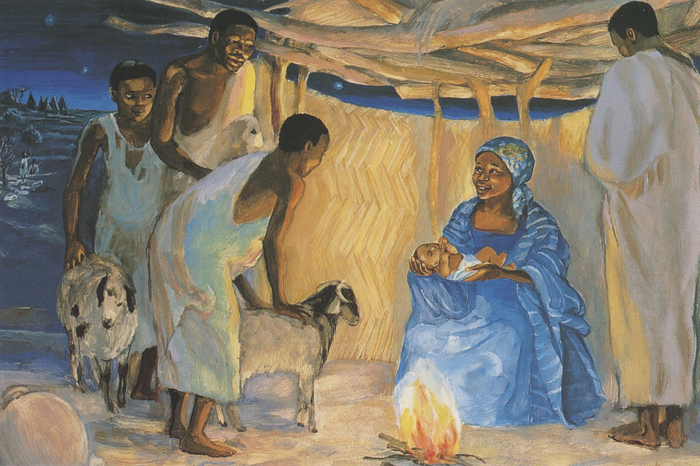
In those days a decree went out from Emperor Augustus that all the world should be registered. This was the first registration and was taken while Quirinius was governor of Syria. All went to their own towns to be registered. Joseph also went from the town of Nazareth in Galilee to Judea, to the city of David called Bethlehem, because he was descended from the house and family of David. He went to be registered with Mary, to whom he was engaged and who was expecting a child. While they were there, the time came for her to deliver her child. And she gave birth to her firstborn son and wrapped him in bands of cloth, and laid him in a manger, because there was no place for them in the inn.
In that region there were shepherds living in the fields, keeping watch over their flock by night. Then an angel of the Lord stood before them, and the glory of the Lord shone around them, and they were terrified. But the angel said to them, “Do not be afraid; for see—I am bringing you good news of great joy for all the people: to you is born this day in the city of David a Savior, who is the Messiah, the Lord. This will be a sign for you: you will find a child wrapped in bands of cloth and lying in a manger.” And suddenly there was with the angel a multitude of the heavenly host, praising God and saying, “Glory to God in the highest heaven, and on earth peace among those whom he favors!”

Reflect
By Rev. Dr. Larry Hayward
I recently read a sermon from a youth minister in another state, named John Weicher, who said,
God so loved the world that God had to love it from the inside, as one of us, instead of from the outside, as a deity…It is a lot easier to love things, people, the world, from afar. From a reasonable distance. From a place where we can stay clean and undisturbed. From the other side of Heaven. But that is not how Jesus was sent to love the world…
Weicher wrote these words about the Gospel of John and the appearance of Jesus to Doubting Thomas. But they jumped out at me about the pastoral and romantic beauty of the Nativity Scene in Luke.
We hear Luke’s story through the heavenly aura surrounding it: angels, shepherds, the Holy Family. It is indeed a story of beauty. But part of the beauty is the precise “insider nature” of the story: “A decree from Emperor Augustus.” “Quirinius was governor of Syria.” “All went to their own towns to be registered.” Then, even more personal “insider” details emerge: “firstborn son,” “wrapped in bands of cloth,” “lying in a manger.” And perhaps most of all: “No room in the inn.”
In the pastoral beauty of the story, it is easy to overlook that this is none other than the “Deity,” the God we worship, coming completely “to the inside” of our world and loving us “from the inside.” This is not a God who loves us “from afar… a reasonable distance… clean and undisturbed.” God loves us “from the inside.”
Many of us are drawn to Christmas services because we implicitly know that they connect us – in fact, draw forth from us – that which is deepest inside us: our joys and sorrows, our successes and setbacks, indeed, our “hopes and fears of all the years.” It is because God in Christ comes “inside” that we open what is inside us to him. Once we do that, it is the start of our being able to love the world Christ came to redeem, starting with the life and people nearest to us.
Prayer: On this night, O Lord, from your inside draw us outward to you and others. Amen.
Listen
By Dr. Ben Hutchens
A Live Recording from Westminster’s Service of Advent Lessons & Carols 2024
The Westminster choir sings for us Distler’s setting of the beloved carol, “Lo! How a Rose E’er Blooming.” Hugo Distler (1908–1942) was a German composer and organist renowned for his contributions to sacred choral music during the early 20th century. Deeply influenced by the music of Johann Sebastian Bach and the polyphonic traditions of the Renaissance, Distler developed a distinctive style characterized by intricate counterpoint, rhythmic vitality, and modern harmonic language. His works often reflect the liturgical and spiritual contexts of his Lutheran faith, as seen in compositions like Die Weihnachtsgeschichte (The Christmas Story). Tragically, Distler’s life was cut short at the age of 34, a victim of the harsh realities and pressures of living under the Nazi regime, which condemned his music as “degenerate.” Despite his untimely death, his works remain a vital part of the repertoire, celebrated for their emotional depth and innovative synthesis of old and new musical traditions.
One of Distler’s notable contributions to the choral canon is his arrangement of “Es ist ein Ros entsprungen” (“Lo, How a Rose E’er Blooming”), a traditional German hymn dating back to the late 16th century. Distler’s version retains the serene beauty and meditative quality of the original melody while infusing it with his characteristic harmonic intricacy and expressiveness. The hymn, associated with the Advent and Christmas seasons, reflects on the birth of Christ as a fulfillment of divine prophecy, symbolized by the blooming rose. Distler’s treatment of the hymn highlights his ability to honor the historical roots of a piece while bringing it into the context of modern sacred music, creating a timeless work that continues to inspire performers and listeners alike.




 wpcadvent
.jpg)