Christmas Eve – December 24

The Word

Luke 1:26-38

In the sixth month the angel Gabriel was sent by God to a town in Galilee called Nazareth, to a virgin engaged to a man whose name was Joseph, of the house of David. The virgin’s name was Mary. And he came to her and said, “Greetings, favored one! The Lord is with you.” 

But she was much perplexed by his words and pondered what sort of greeting this might be. The angel said to her, “Do not be afraid, Mary, for you have found favor with God. And now, you will conceive in your womb and bear a son, and you will name him Jesus. He will be great, and will be called the Son of the Most High, and the Lord God will give to him the throne of his ancestor David. He will reign over the house of Jacob forever, and of his kingdom there will be no end.” 

Mary said to the angel, “How can this be, since I am a virgin?” The angel said to her, “The Holy Spirit will come upon you, and the power of the Most High will overshadow you; therefore the child to be born will be holy; he will be called Son of God. And now, your relative Elizabeth in her old age has also conceived a son; and this is the sixth month for her who was said to be barren. For nothing will be impossible with God.” 

Then Mary said, “Here am I, the servant of the Lord; let it be with me according to your word.” Then the angel departed from her.

Art by Janet Hawkins.

Reflect

By Janet Hawkins

As a child, I began anticipating Christmas soon after the Sears catalogue (the size of an encyclopedia!) appeared in our mailbox in August. I would spend hours thumbing through it, folding over page edges – gentle hints to Santa, the “must have” toys on my list.

My father would bring home two stockings in October for me to fill for local children in need. I was given five dollars per stocking to purchase small gifts at the local variety store. I never knew anything about the children, but I was hopeful they accepted the stockings as a gift of love from my family.

In November, my Sunday School class assembled a “take home” Advent kit. We painted the wooden candleholders, and then the class assembled Advent booklets. I have kept those Advent books ever since, and when I was recently looking at them again, I immediately noticed someone was missing from the assigned scripture, prayers, and hymns: Mary. After Gabriel appears to Mary, there is no mention of her until Christmas Eve, when she and Joseph arrive at the stable for the birth of Jesus.

Looking for answers, I referred to my childhood Bible (the Revised Standard Version):

Gabriel said, ‘Do not be afraid, for you have found favor with God. And you will conceive in your womb a son and you shall call him Jesus…He will be great … And Mary said, ‘How can this be since I have no husband?… And Gabriel said to her, “The Holy Spirit will come upon you and the power of the most high will overshadow you.” … Mary said, “Behold: I am the handmaid of the Lord, let it be to me according to your word.” (Luke 1: 30)

In retrospect, these verses may have been difficult to explain to a grade school Sunday School class. I can’t recall Mr. White’s Luke 1 lesson, although I suspect he focused less on conception and moved on to Luke 2 (when Jesus is lying in the manger).

Today, however, I wonder about Mary. What was her reaction after being told she was going to be a mother? Mary was most likely a teenager. Surely, she had questions. Why me? Perhaps she was frightened about her future. Instead, Mary asked only one question: “How can this be?” After listening to Gabriel’s response, she answered: “Let it be.”

In my own life, “first world problems” often overwhelm me. When I am struggling, I pray and am pleasantly reminded that my faith gives me strength as well as support during difficult times or even when I ask, “why me?” By accepting that God has my back, I carry on and know I will get through whatever seems to be troubling me.

Rather than focusing on being “merry” this holiday season; let’s instead focus on “Mary.” Receiving God’s blessing, she took a leap of faith and willingly accepted her role in Christ’s birth. Mary’s faith is a gentle reminder to joyfully accept God’s gift of love – the birth of our Lord, Jesus Christ.

Listen

By Dr. Ben Hutchens

As we end our preparations for Christmas, the combined choirs of Westminster – Adults, Choristers, and Children – join in singing American composer Carolyn Jennings’ setting of “Climb to the Top of the Highest Mountain.” The season of Advent draws us and our attention to the great and mighty wonder in the coming of the Christchild; this anthem provides a music setting of the same. It begins quietly with the children’s voices. After a few minutes we are reminded of Christ’s triumphant second coming in power and glory. The anthem ends as it begins, quietly, as the youngest voices implore us to “love and trust him as a child.”  

May the peace of God be with you this Christmastide as we worship the Christchild with friends around the world, and also with those who worship with us but on another shore and in a greater light. Merry Christmas!

Climb to the top of the highest mountain, joyous tidings proclaim to the world,
Lift up your voice, shout the good news: behold, your Lord comes to you.
He will feed his flock like a shepherd, he will carry the lambs in his arms,
He will ever keep them safe from harm. Behold, your Lord comes to you.
He who made the stars in the heaven, He who fashioned the earth and the sea,
From time eternal he was God, the Alpha and Omega, he. Behold, your Lord!
He will come in power and glory, he will rule with mercy and truth,
Hope of the nations, light of all the world.
He will love the little children, he will hold them in his arms.
Love him and trust him as a little child. Behold, your Lord comes to you.
Fourth Sunday of Advent – December 17

The Word

John 1:6-8, 19-28

There was a man sent from God, whose name was John. He came as a witness to testify to the light, so that all might believe through him. He himself was not the light, but he came to testify to the light.

This is the testimony given by John when the Jews sent priests and Levites from Jerusalem to ask him, “Who are you?” He confessed and did not deny it, but confessed, “I am not the Messiah.” And they asked him, “What then? Are you Elijah?” He said, “I am not.” “Are you the prophet?” He answered, “No.” Then they said to him, “Who are you? Let us have an answer for those who sent us. What do you say about yourself?” He said, “I am the voice of one crying out in the wilderness, ‘Make straight the way of the Lord,’” as the prophet Isaiah said. Now they had been sent from the Pharisees. They asked him, “Why then are you baptizing if you are neither the Messiah, nor Elijah, nor the prophet?” John answered them, “I baptize with water. Among you stands one whom you do not know, the one who is coming after me; I am not worthy to untie the thong of his sandal.” This took place in Bethany across the Jordan where John was baptizing.

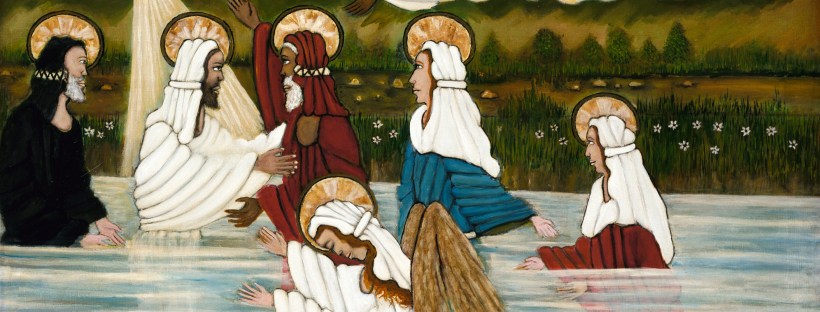
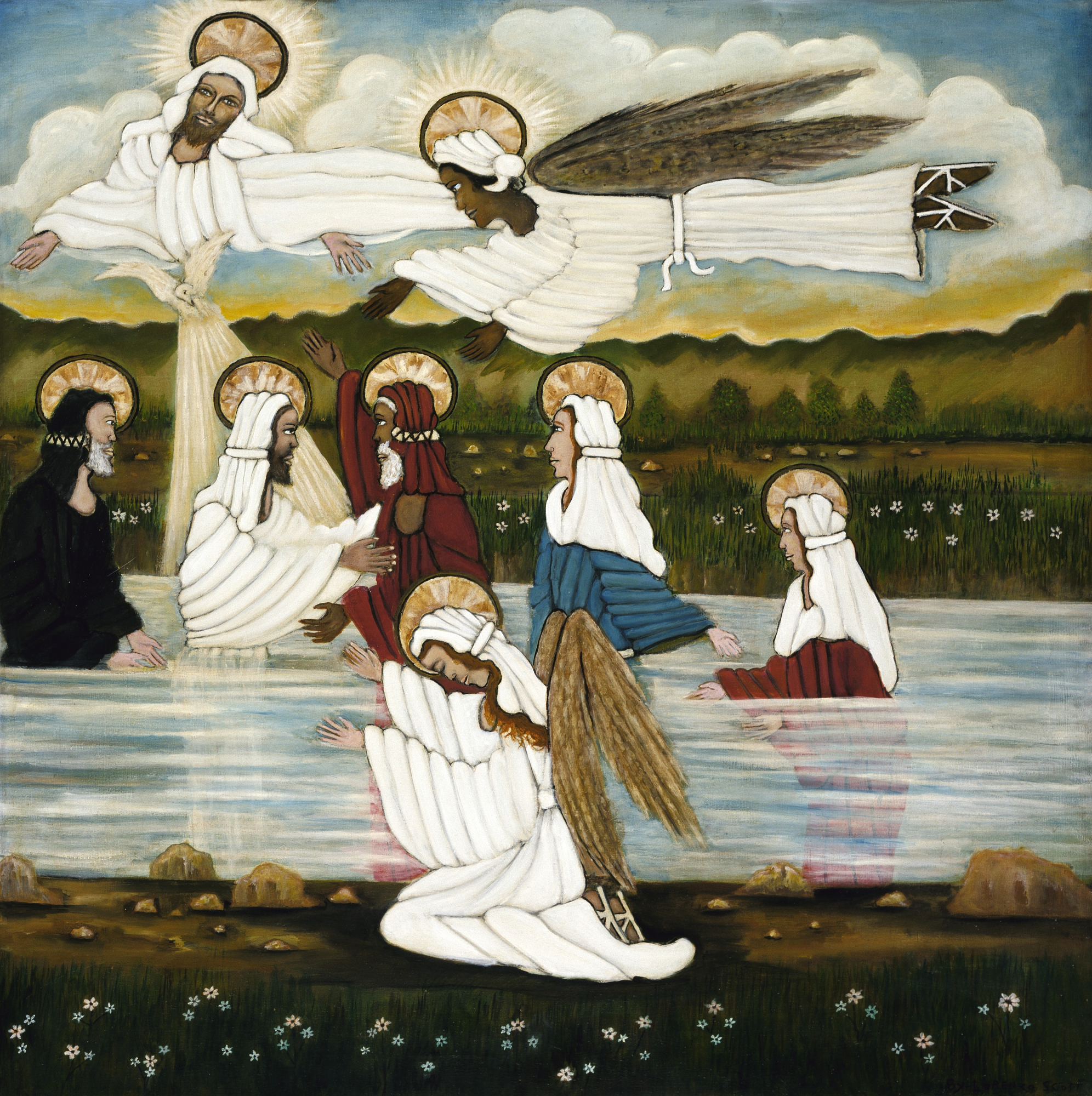
Lorenzo Scott, Baptism of Jesus, 1987, oil on canvas, 48 18 x 48 18 in. (122.3 x 122.3 cm.), Smithsonian American Art Museum, Gift of Jane and Bert Hunecke, 1994.52

Reflect

By Lisa Shaw

I’ve always felt wary of people who draw attention to their Christianity, but who judge, punish, and exclude others who don’t look or act like them. For me, announcing my faith feels too personal, evangelizing too imperious; like the Pharisees demanding answers to their questions. Indeed, even writing a devotional was a foreign concept to me before joining Westminster. In the church I attended as a child, it wasn’t practiced, leaving me to feel that maybe now I don’t have enough to say.

But my experiences over the years have opened my eyes and heart to other ways of doing things and new ways of thinking, new ways to bear witness. To me, God is less in pageantry, faithful Sundays, and recitations of the Bible and more in the small gestures of ordinary people, going about sometimes ordinary lives.

In our scripture reading, John denies being the Messiah. He is not the one to claim his righteousness or collect accolades for his work but embraces his role in welcoming and guiding others. In our world, particularly with our daughter Helena, small gestures by unassuming people live on in and around me: the ICU nurse who styled Helena’s hair while she lay unconscious in the hospital; the burly workman who approached us with tears in his eyes to give her a compliment; my friend who always remembers to leave flowers at our doorstep on Helena’s birthday. These individuals humbly walk among us, their voices, like John’s, quietly calling in the wilderness. Their efforts, more than grandiose proclamations or public displays of devotion, “make straight the way for the Lord.”

I am witness.

Listen

By Dr. Ben Hutchens

The Westminster Choristers sing a new setting of the traditional carol, “Adam lay ybounden.” It is a setting of an anonymous fifteenth century poem that speaks to the subject of original sin and subsequent redemption in the person of Jesus Christ. The premise of the poem is this: if Adam had not been tempted by Eve directly—and the serpent indirectly—there would have been no precedent for sin as we understand it; consequently, there would be no need for redemption. As such, the birth of Christ would not have been necessary as far as the Christian understanding of things is concerned. The sin of Adam constrained the development of humanity’s relationship with God for many centuries, until God himself became flesh and dwelt among us. Mary’s birthing of Jesus, as alluded to in the poem itself, allowed human beings to literally touch the face of God through his Son.  

The carol was published in 2015 and popularized through its inclusion in the 2016 Christmas Lessons & Carols program at King’s College, Cambridge. The composer, Gaynor Howard, has been involved in music education throughout her working life. She has arranged and written much instrumental and vocal music for a wide variety of occasions and forces. Her setting of “Adam lay ybounden” is written for treble voices only—a perfect fit for our choristers. Listen for the juxtaposition of the angular piano accompaniment—executed beautifully by Christine Hagan—and the lyrical vocal lines sung by our choristers.

Third Sunday of Advent – December 10

The Word

Isaiah 40:1-11

Comfort, O comfort my people, says your God. Speak tenderly to Jerusalem, and cry to her that she has served her term, that her penalty is paid, that she has received from the Lord’s hand double for all her sins.

A voice cries out: “In the wilderness prepare the way of the Lord, make straight in the desert a highway for our God. Every valley shall be lifted up, and every mountain and hill be made low; the uneven ground shall become level, and the rough places a plain. Then the glory of the Lord shall be revealed, and all people shall see it together, for the mouth of the Lord has spoken.” A voice says, “Cry out!” And I said, “What shall I cry?” All people are grass, their constancy is like the flower of the field. The grass withers, the flower fades, when the breath of the Lord blows upon it; surely the people are grass. The grass withers, the flower fades; but the word of our God will stand forever.

Get you up to a high mountain, O Zion, herald of good tidings; lift up your voice with strength, O Jerusalem, herald of good tidings, lift it up, do not fear; say to the cities of Judah, “Here is your God!” See, the Lord God comes with might, and his arm rules for him; his reward is with him, and his recompense before him. He will feed his flock like a shepherd; he will gather the lambs in his arms, and carry them in his bosom, and gently lead the mother sheep.

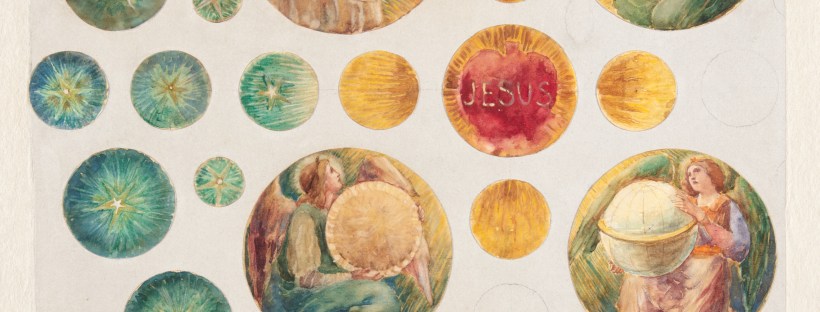
“Study for Rose Window for St. John the Baptist Church, Brooklyn, NY.” Leon Dabo, American, 1868–1960. Cooper Hewitt, Smithsonian Design Museum Collection.

Reflect

By Peter Roden

This text from Isaiah has a strong sense of the same push-and-pull that we all feel in our daily lives. In the prophecy, Isaiah compares the God of Israel, bringing the people back from exile in Babylon, to a shepherd carrying lambs. This joyous occasion comes after a period of seclusion and suffering. Although the return is celebrated it comes with new tasks, and the nation is forever changed by the experience of Exile.

It is hard in such context to avoid comparison to our own modern Exile during the pandemic shutdown. Like the people of Judah, we will be forever changed by that experience. Our common language has gained new phrases and expresses ideas previously foreign to us. Similarly, the writer of Isaiah borrows from the Babylonians their practice of building a parade-route—“make straight in the desert a highway”—for celebration of God.

Isaiah’s imagery is of a council of angels, sent by God to comfort his people; to speak tenderly. Instead, the council’s response to this is quite a lot of shouting, in addition to orders for road work! The angels remind us that we are God’s hands in the world. God is not building the highway; it is we who are called to build the highway, to shout the Good News, and to make God’s kingdom visible for all the people. If we don’t, the peoples’ faithfulness is sure to wither like grass.

And yet, our work is not enough. Worldly works fade, and only God is all-sufficient. God’s word and God’s promise are forever. Just as Isaiah calls back to Jacob’s charge in Genesis to return with his flock, so does John the Baptist call back to this charge from Isaiah. God’s word from these three disparate time periods resounds across the ages to us, ringing true once more.

In this season of anticipation, we look forward to welcoming, proclaiming, and making a path for Jesus in the desert. We can rest assured that God’s Word endures, for He was with God in the beginning, He comes again in power, and His reward is with Him.

Listen

By Dr. Ben Hutchens

Westminster’s Adult Choir sings a favorite anthem, “E’en So, Lord Jesus, Quickly Come,” by American composer Paul Manz. This anthem is a perennial favorite of our choir and I most often program it during the seasons of Advent.  Of course, the text not only provides us with a sense of longing for the coming of the Christ Child, but also for the promised return of Jesus, our Great High Priest. Paul and (wife) Ruth Manz wrote “E’en So, Lord Jesus, Quickly Come” in 1953 during a time when their three-year-old son was critically ill. Reflecting on the time, Ruth Manz reported, “I think we’d reached the point where we felt that time was certainly running out so we committed it to the Lord and said, ‘Lord Jesus quickly come.'” During this time, she had prepared some text for Paul for a composition based on the Book of Revelation. While at his son’s bedside, Paul Manz began drafting the composition, which later became the current piece. Their son did recover, which the couple attributed to the power of prayer.

Second Sunday of Advent – December 3

The Word

Mark 13:24-37

“But in those days, after that suffering,

the sun will be darkened,
and the moon will not give its light,
and the stars will be falling from heaven,
and the powers in the heavens will be shaken.

Then they will see ‘the Son of Man coming in clouds’ with great power and glory. Then he will send out the angels, and gather his elect from the four winds, from the ends of the earth to the ends of heaven.

“From the fig tree learn its lesson: as soon as its branch becomes tender and puts forth its leaves, you know that summer is near. So also, when you see these things taking place, you know that he is near, at the very gates. Truly I tell you, this generation will not pass away until all these things have taken place. Heaven and earth will pass away, but my words will not pass away.

“But about that day or hour no one knows, neither the angels in heaven, nor the Son, but only the Father. Beware, keep alert; for you do not know when the time will come. It is like a man going on a journey, when he leaves home and puts his slaves in charge, each with his work, and commands the doorkeeper to be on the watch. Therefore, keep awake—for you do not know when the master of the house will come, in the evening, or at midnight, or at cockcrow, or at dawn, or else he may find you asleep when he comes suddenly. And what I say to you I say to all: Keep awake.”

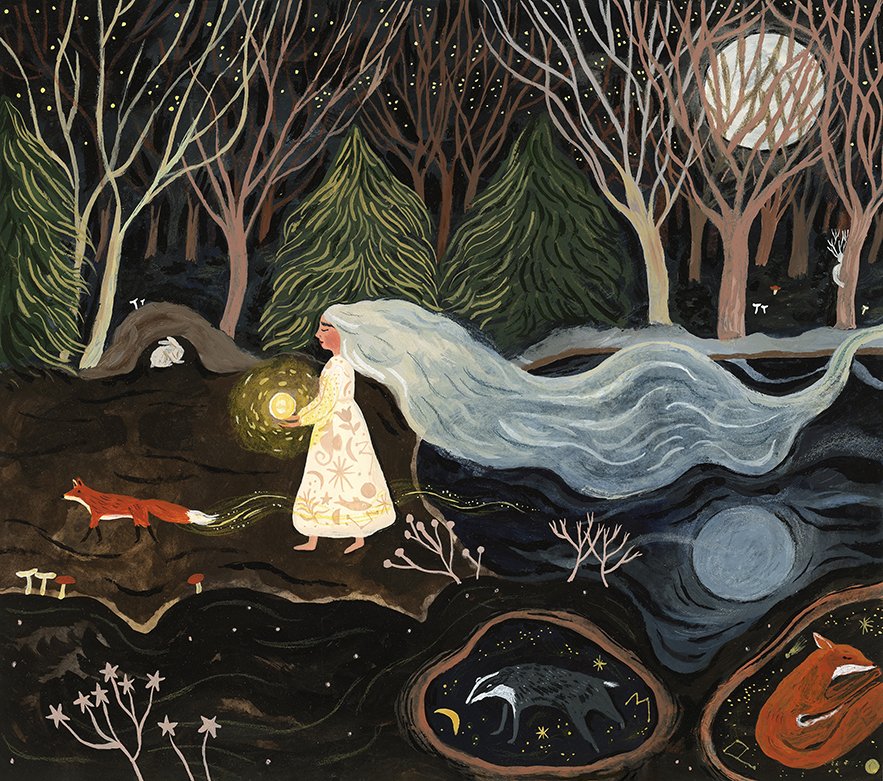
“Light in the Dark.” instagram.com/tjanadraws

Reflect

By Kay Sidahmed

“Macht hoch die Tür, die Tor macht weit” (”Lift high the door, the gates draw wide”) is one of the German advent hymns very dear and near to my heart and soul, and I made sure to teach it to my children as soon as they could somewhat carry a tune. To this day, during advent season we gather around the piano on most mornings for a quick two minutes of song before they head out the door into the business of their school day. “Macht hoch die Tür” is a staple in our advent morning song rotation, as is “People, Look East,” a hymn I was first introduced to at my children’s preschool and have cherished ever since. Both hymns, as different as they may be in setting and tone, are an invitation to mindful preparation and presence: preparing and being present for Love, my personal preferred synonym for God, in all the different shapes, forms, and ways Love may come our way.

Mindfulness has become quite a buzzword in recent years, for good reason in my opinion, as we find ourselves becoming ever more distracted, ungrounded, and disconnected from one another and the purpose of our existence. As a collective, we find ourselves in an epidemic of unease and restlessness. The root cause of this feeling is disconnection from nature and from our essence of being. Buddhist monk Thich Nhat Hanh coined the term interbeing as a reminder of our inextricable connectedness with everyone and everything, a concept that he beautifully brings to light in his many writings. The same concept was and is the cornerstone of the ministry and teachings of Jesus.

It is from this notion of interbeing that I find myself honoring and celebrating the rhythm of the Christian year closely woven together with the rhythm of the solar year, the seasonal changes, and the ways of nature. Since the beginning of time, pre-Christian and Indigenous communities in all corners of the world have been honoring the wheel of the year with traditions and rituals reflecting their respective geographic location and cultural backdrop. They all have in common a deep reverence for the ultimate ways and rhythms of nature and a humble recognition that being mindfully present to and with these rhythms is what sustains us as creatures of nature.

If we make space for this presence and interbeing to enter our lives, we allow ourselves to pause, slow, down, retreat, and rest, just as the seeds below the ground and the hibernating animals do during the winter season. This rest is essential for survival as it allows us to process and gather the resources and nourishment to enter a new cycle, bringing forth new life as the days get longer and warmer. The arc of Advent, Christmas, Candlemas, and Easter reveals its myriad opportunities for connection and healing when we understand it also as an invitation to commune with the earth and nature’s events during the time of the winter solstice through the spring equinox.

Tuning into the darkening and shortening of daylight and following its call to retreat and rest allows us to truly connect with the spirit of Christ and Love, to renew and reseed our commitment to crossing the bridge of separation and othering, and to follow the teachings of Jesus in our lives as we ready ourselves for the emergence of another spring. By accepting this invitation during Advent to pause, light a candle, and gather in quietude, we truly open ourselves and become present to the almost overwhelming magnitude of light that the ever-present Christ has in store for us. Surrendering to this season, with humility to the intimate union of Nature and Love as our guides, keeps us mindfully prepared, present, and connected to receive and bring forth this light of Christ in each other’s lives.

“The Shortest Day” by Susan Cooper

And so the Shortest Day came and the year died
And everywhere down the centuries of the snow-white world
Came people singing, dancing,
To drive the dark away.
They lighted candles in the winter trees;
They hung their homes with evergreen;
They burned beseeching fires all night long
To keep the year alive.
And when the new year’s sunshine blazed awake
They shouted, reveling.
Through all the frosty ages you can hear them
Echoing behind us—listen!
All the long echoes, sing the same delight,
This Shortest Day,
As promise wakens in the sleeping land:
They carol, feast, give thanks,
And dearly love their friends,
And hope for peace.
And now so do we, here, now,
This year and every year.
Welcome, Yule!

Listen

By Dr. Ben Hutchens

Westminster’s Jubilate Ringers provide the music for Advent 2. “People, Look East” first appeared in The Oxford Book of Carols (1928). The lively tune, a traditional French carol BESANÇON, which earlier appeared with the anonymous text, “Shepherds, shake off your drowsy sleep,” provides a festive setting for this wonderful Advent text. The piece opens with music that reminds me of a camel walking through the desert. Composer Linda Lamb achieves this effect by employing malleted ringing: you’ll notice our youth ringers leave the bells on the tables throughout this section. With the aural scene set, we hear the familiar tune in the upper bells on top of the walking camel music. The piece grows in intensity and then fades, ending as it began with the camels softly waking in the desert.

First Sunday of Advent – November 26

The Word

Mark 1:1-8

The beginning of the good news of Jesus Christ, the Son of God.

As it is written in the prophet Isaiah,
“See, I am sending my messenger ahead of you,
who will prepare your way;
the voice of one crying out in the wilderness:
‘Prepare the way of the Lord,
make his paths straight,’”

John the baptizer appeared in the wilderness, proclaiming a baptism of repentance for the forgiveness of sins. And people from the whole Judean countryside and all the people of Jerusalem were going out to him, and were baptized by him in the river Jordan, confessing their sins. Now John was clothed with camel’s hair, with a leather belt around his waist, and he ate locusts and wild honey. He proclaimed, “The one who is more powerful than I is coming after me; I am not worthy to stoop down and untie the thong of his sandals. I have baptized you with water; but he will baptize you with the Holy Spirit.”

Art by Amy Stenlund

Reflect

By Betsy Preston

My family loves a good story – especially Christmas stories. Every year we put out some of our favorites: A Christmas Carol, A Visit from St. Nicholas, The Polar Express, to name a few. And every Christmas Eve ends with hanging stockings and reading the Christmas Story from Luke. We also love to tell our own family stories of Christmas:

I’m often teased about the year I made Christmas cards from construction paper as an enterprising elementary child – complete with pricing – and sold them to family members for extra shopping money.

My brother wishes we all would forget the year he came home from preschool and asked to sing the O-O-O song, which my parents finally figured out was Angels We Have Heard on High – but in our family, it will forever be the O-O-O song. (Think: “Glo-o-o-o-o-ria, in Excelsis Deo.”)

We’re in our fifth generation of placing an apple, an orange, and a “bit of chocolate” in the toe of our Christmas stockings…a family tradition dating to the days of the Great Depression, a time when fruit and candy were extravagant Christmas treats.

Our family stories sometimes differ a bit depending on who tells them, and where we focus the narrative, but all are told with love and meaning as we pass along an oral history from one generation to the next. The story of our Christmas stocking tradition is especially poignant, as it reminds us each year of family members who came before and paved the way for what we share now. We, too, are conscious of passing along their strength to new generations.

As a church this year, we have spent time remembering and sharing our collective story, thinking about who has paved the way and who we are today. We are planning another trip to Israel with our Jewish friends to deepen our shared faith heritage, and we have been to Scotland to study our Reformation roots. We have reviewed and renewed Westminster’s response to racism and racial tension, beginning with Cliff Johnson’s sermons on these topics in the early days of the church’s founding and culminating with a visit to the American south that is further informing our congregational work decades later.

In our gospel story today, the evangelist Mark dives right into the action. He leaves the pastoral nativity to later-generation storytellers such as Matthew and Luke. Mark urgently focuses on the narrative of John the Baptist, who paved the way while telling the crowds that another was coming after him, more powerful and far more worthy. John baptized with water; the one coming after would baptize with the Holy Spirit.

Mark wants us to know the arc of the generations in our faith family – not the “begats” of Matthew, but the ones who made the way. John the Baptist paved the way for Jesus and His ministry. Jesus paved the way for us to minister through the Holy Spirit. Mark tells the story differently from anyone else, and it is exciting for us to think about the reasons that Mark begins at the river, rather than at the manger.

As you contemplate today’s scripture, consider also your favorite stories and storytellers, in family and in faith, as well as the people of whom the stories are told. Who has paved the way and how are you paving the way for those who are yet to come? What part of the story will someone tell next?

Listen

By Dr. Ben Hutchens

This week, our adult bell choir rings in the season of Advent with the familiar carol, “Angels We Have Heard On High.” Though the source of the song is unknown, it is believed to have originated in 18th century France; the earliest known printed version was in an 1842 French song book. The song was first translated into English in 1860 by James Chadwick, a Roman Catholic bishop.

American composer Barbara Kinyon provides a festive setting for us today. She begins with a “music box” pattern in the upper bells, then shortly after the piece begins, the tune appears in the middle bells. Kinyon makes good use of various handbell techniques—including shakes and martellatos (when bells are “hammered” into the table pad)—to highlight the resounding joy this piece brings to us.