
The Word
Micah 5:2-5
But you, O Bethlehem of Ephrathah, who are one of the little clans of Judah, from you shall come forth for me one who is to rule in Israel, whose origin is from of old, from ancient days. Therefore he shall give them up until the time when she who is in labor has brought forth; then the rest of his kindred shall return to the people of Israel. And he shall stand and feed his flock in the strength of the Lord, in the majesty of the name of the Lord his God. And they shall live secure, for now he shall be great to the ends of the earth; and he shall be the one of peace. If the Assyrians come into our land and tread upon our soil, we will raise against them seven shepherds and eight installed as rulers.
Reflect
By Melynda Wilcox
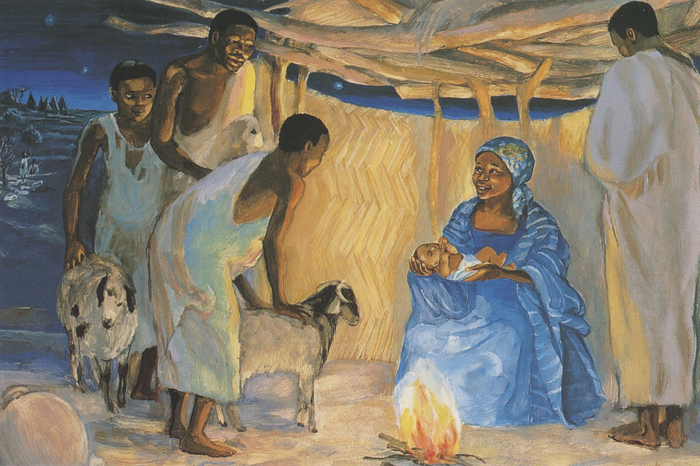
Small-town boy makes good in the big city and puts his village on the map—the stuff of books and movie scripts. And that’s the scene that the prophet Micah sets in chapter 5, verse 2, as he foretells that Bethlehem, despite being one of the smallest clans in all of Judah, will be the birthplace of the Messiah. Some translations of this verse imply that Bethlehem is too small even to be considered a clan of Judah—barely big enough to warrant a stop sign let alone a stoplight at the crossroads. And with its small size, Bethlehem is unlikely to have been of any consequence in the geopolitics of antiquity.
Once again, God returns to the recurring Biblical theme of choosing the least likely person from the least significant place to advance God’s purposes in the world. In this backwater hamlet, of all places, a baby born to a young unmarried girl will become the messenger of God’s salvation, “the one of peace.” Bethlehem will be forever changed. The world will be forever changed.

The tradition of miniature nativity scenes, which began more than 1,500 years ago as a way to give ordinary people—who lived miles away from a church—access to the divine, is evocative of Micah’s description of Bethlehem. Retablos made in Central and South America were designed inside small boxes with hinges and latches so that they would be portable for traveling priests. Hollowed-out walnut shells and gourds are also popular containers for small manger scenes. The Washington National Cathedral has a nativity scene that is painted on the head of a pin among its impressive collection of crèches. The miniature world of the nativity, beautiful but fragile in its diminutive form, transports us back to a tiny place called Bethlehem.
As the journey to Bethlehem unfolds, pause to observe more closely—and perhaps more patiently—the small or seemingly inconsequential occurrences in daily life: the curious insect on the windowsill, the unusual shape of a cloud, the trajectory of a falling leaf, the strangers you pass in the frozen food aisle, the smiles between a mother and child from across the waiting room. Take a moment to think of Bethlehem.
Listen
By Dr. Ben Hutchens
A Live Recording from Westminster’s Service of Advent Lessons & Carols 2024
The Children (and congregation) of Westminster lead us in this week’s devotion. The Advent wreath is a Christian tradition that symbolizes the passage of the four weeks leading up to Christmas. Typically made from evergreen branches, the circular shape of the wreath represents eternity and the everlasting nature of God’s love. Four candles are placed around the wreath, with a fifth candle often positioned in the center. Each candle is lit successively on the Sundays of Advent, representing the growing anticipation of Christ’s coming as the Light of the World. The colors of the candles— three purple and one pink—reflect themes of penance, preparation, and joy. The pink candle, lit on the third Sunday, symbolizes Gaudete Sunday, a moment of rejoicing in the midst of Advent’s reflective tone.
The center candle is the Christ Candle, traditionally white and lit on Christmas Eve or Christmas Day to celebrate the birth of Jesus. Each week, the lighting of a new candle is often accompanied by Scripture readings, prayers, and hymns, creating a ritual that fosters reflection and community. Beyond its liturgical significance, the Advent wreath has become a cherished tradition in homes and churches alike, offering a tangible reminder of hope, peace, joy, and love—the key themes of the season. Its simplicity and profound symbolism make it a meaningful centerpiece of Advent worship and devotion.
 wpcadvent